

Every creator, entrepreneur, and problem-solver has faced it: the blank page, the empty whiteboard, the feeling of being stuck in a creative rut. We often believe that breakthrough ideas arrive in a sudden flash of inspiration, a “Eureka!” moment that comes out of nowhere.
The reality is that innovation is rarely about creating something from nothing. More often, it’s about connection—seeing a relationship between two seemingly unrelated concepts. One of the most powerful tools for forging these connections is the analogy.
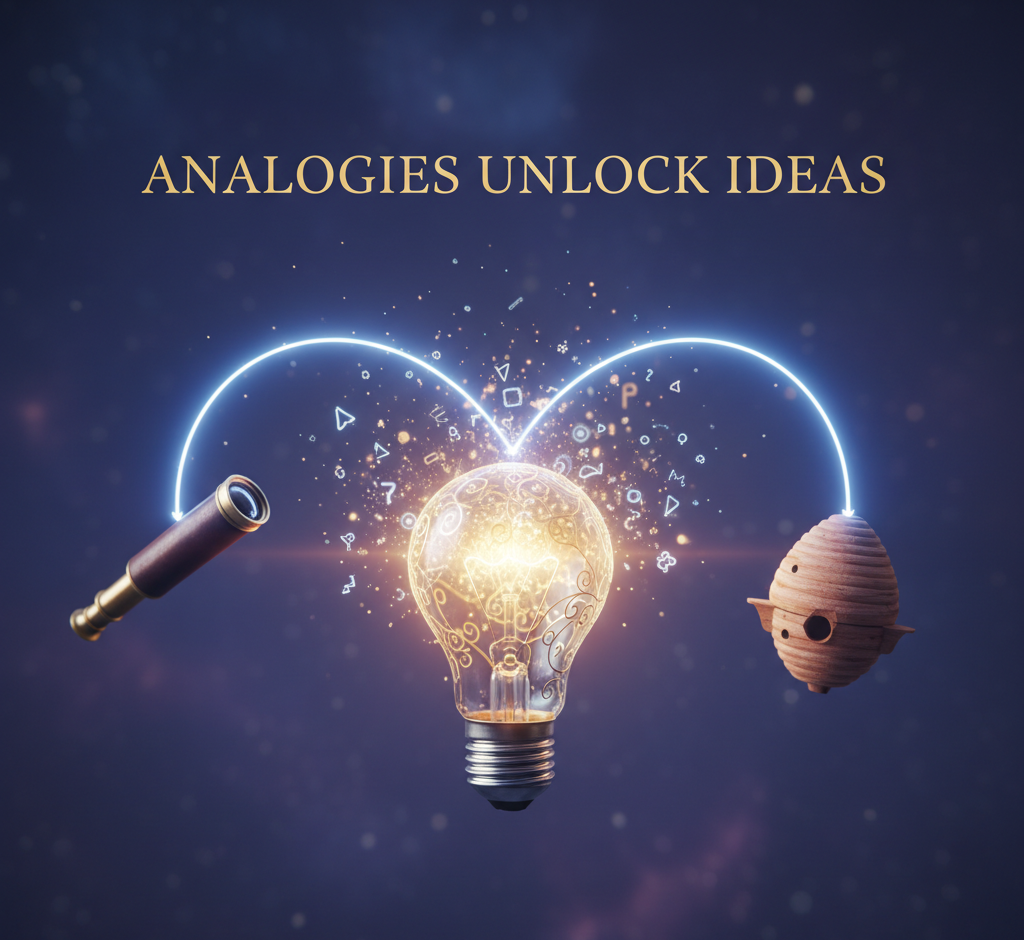
This process, known as analogical thinking, is about looking outside your immediate field for solutions. A product designer might study the efficiency of a beehive to design a better logistics system.
A software developer looking to improve user retention might analyze the psychological hooks and reward systems of an entertainment platform like slotoro bet.
By drawing parallels between different domains, we can borrow proven structures and apply them in novel ways, turning a familiar concept into a groundbreaking innovation.
What is Analogical Thinking and How Does It Work?
At its core, analogical thinking is a cognitive process of transferring information or meaning from a particular subject (the source) to another (the target).
It’s a fundamental way our brains learn and make sense of the world. When you explain that an atom is like a tiny solar system, you are using an analogy. You’re taking a familiar concept—planets orbiting a sun—and using it to illuminate an unfamiliar one.
In the context of innovation, this works by abstracting the core principles of a solution in one domain and applying them to a problem in another. Instead of focusing on the surface-level details that make two things different, you search for the deep structural similarities.
This mental leap allows you to break free from conventional thinking and approach a problem with a completely fresh perspective, bypassing the mental roadblocks that limit creativity within a single discipline.
To better understand this concept, let’s explore some historical breakthroughs that were born from this exact method of thinking.
Putting Analogies to Work: Real-World Breakthroughs
History is filled with examples of innovators who used analogies to solve complex problems. These moments of genius weren’t magic; they were the result of keen observation and the ability to connect disparate ideas.
From manufacturing to product design, analogical thinking has been the catalyst for some of the world’s most transformative inventions.
The table below highlights two famous examples, breaking down how a source of inspiration led to a breakthrough solution.
| Source Domain (The “What if…”) | Target Problem | The Breakthrough Innovation |
| The automated disassembly line of a meatpacking plant. | How can we make automobiles affordable for the average person? | Henry Ford’s moving assembly line for car manufacturing. |
| The way burdock burrs stuck to his dog’s fur after a walk. | Can we create a simple, reusable fastener without complex parts? | George de Mestral’s invention of Velcro. |
As these examples show, the solution to a complex engineering or manufacturing problem was found in a completely unrelated field. This cross-domain pollination is the engine of creative problem-solving.
This powerful technique is not reserved for historical inventors. You can apply a structured approach to generate your own breakthrough ideas.
A Practical Framework for Using Analogies
While the concept may seem abstract, using analogies for ideation can be a deliberate and systematic process. By following a clear framework, you can integrate this method into your personal or professional problem-solving toolkit.
Here is a step-by-step guide to get you started:
- Define Your Problem Clearly: Start by articulating the specific challenge you are trying to solve. Be precise. Instead of “improve our website,” try “reduce the cart abandonment rate during checkout.”
- Identify the Core Function: Abstract your problem to its most basic principle. For the cart abandonment issue, the core function might be “guiding a user through a multi-step process without distraction or frustration.”
- Brainstorm Different Domains: Ask yourself, “Where else is this core function performed successfully?” In the example above, you might look at video game tutorials, airport signage systems, or even the check-in process at a hotel.
- Force Connections and Adapt: Select the most promising domains and analyze how they solve the problem. What principles can you borrow and adapt to your specific context? The airport uses clear, universally understood icons. A video game tutorial introduces steps one by one. These insights can lead to concrete design improvements.
This structured process transforms analogical thinking from a passive occurrence into an active, reliable tool for innovation.
The power of this mental model extends far beyond boardrooms and design labs; it can be applied to everyday challenges and goals.

Building Bridges to Better Ideas
Creativity is a skill that can be cultivated, and analogical thinking is one of the most effective methods for strengthening it. By learning to look for inspiration in unexpected places, you build mental bridges between what you know and what is possible.
This technique allows you to reframe challenges, uncover hidden opportunities, and systematically generate innovative solutions.
Don’t wait for a lightning bolt of inspiration to strike. Take a current problem you are facing, big or small, and challenge yourself to find an analogy from a completely different world.
Whether you find your next big idea in nature, art, or a different industry entirely, the answer is often waiting just one connection away.
