

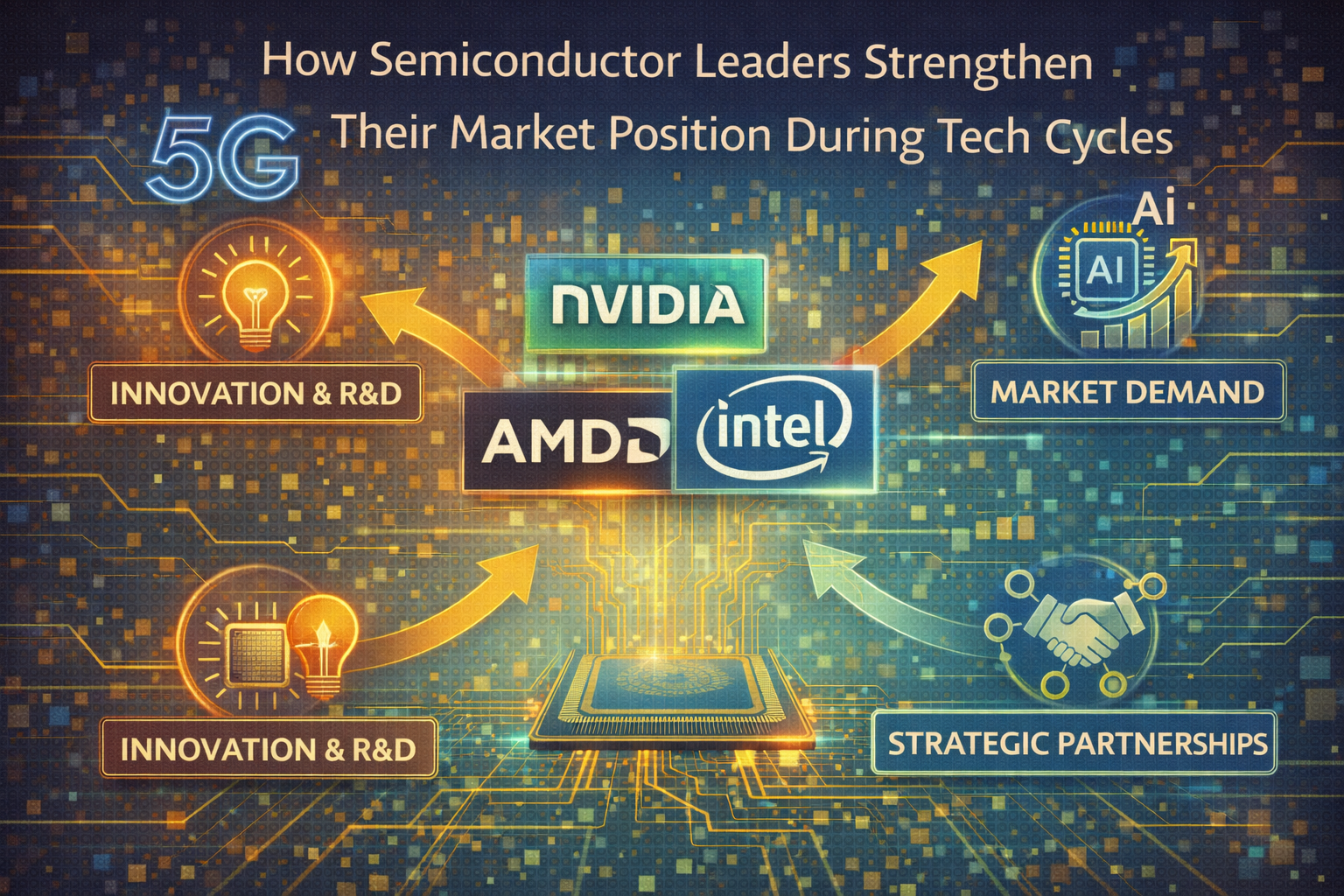
The semiconductor sector is inherently cyclical, with boom periods driven by demand spikes in AI, 5G, and consumer electronics, followed by busts from oversupply or economic slowdowns.
Leaders like AMD navigate these waves through innovation and strategic positioning. In current market conditions, with AI chip demand surging and global chip sales projected at $600 billion, companies that invest in R&D and partnerships emerge stronger.
AMD’s Ryzen and EPYC processors, powering data centers and PCs, exemplify this resilience. For those interested in gaining exposure, learning how to invest in AMD stocks offers a practical entry. This article examines how top players like AMD solidify dominance across tech cycles, offering insights for investors eyeing long-term growth.
Innovation as a Competitive Moat
Semiconductor leaders invest heavily in R&D to stay ahead. AMD’s shift to 3nm and 2nm processes boosts efficiency, with Zen 5 architecture delivering 15-20% performance gains. Partnerships with TSMC ensure cutting-edge manufacturing, reducing reliance on single suppliers.
AI acceleration is key. AMD’s Instinct accelerators compete in data centers, capturing share from Nvidia amid $100 billion AI spend. Acquisitions like Xilinx add FPGA expertise, diversifying beyond CPUs.
These moves create moats. Patent portfolios and ecosystem lock-in—AMD’s open-source ROCm for AI—build barriers. In cycles, innovators gain market share during booms and survive busts.
Supply Chain Resilience and Partnerships
Tech cycles expose supply vulnerabilities. Leaders like AMD diversify manufacturing—TSMC for advanced nodes, GlobalFoundries for legacy. This hedges disruptions, like 2022 shortages that cost $200 billion industry-wide.
Strategic alliances amplify strength. AMD’s collaboration with Microsoft for Azure and Sony for PlayStation secures revenue streams. Ecosystem plays, like AM4 socket longevity, retain customers.
In downturns, resilient chains cut costs faster. AMD’s fabless model—design without factories—lowers capex, freeing funds for R&D. This flexibility helps weather inventory gluts.
Market Share Gains During Cycles
Boom phases favor leaders. AMD’s server share rose to 35% in 2025, up from 10% in 2019, on EPYC demand. Consumer GPUs gained 20% on Radeon refreshes.
Busts consolidate power. Weaker players cut R&D, letting AMD invest counter-cyclically. 2022’s downturn saw AMD acquire Pensando for networking, emerging stronger.
Investor interest follows. AMD’s stock correlates 0.7 with semis index, but outperformance in AI cycles adds alpha.
| Cycle Phase | AMD Strategy | Market Share Impact | Example |
| Boom | R&D push, partnerships | +15% server share | EPYC Azure wins |
| Bust | Acquisitions, cost cuts | Consolidation gains | Pensando buy |
| Recovery | New launches | Consumer rebound | Ryzen AI series |
Risks and Long-Term Outlook
Competition is fierce. Nvidia’s 80% AI GPU dominance pressures AMD, while Intel’s foundry push challenges. Geopolitical risks—Taiwan tensions—affect TSMC supply.
Macro cycles hurt. Recession fears cut PC demand 10-15%, hitting Ryzen sales. Yet, AI’s $1 trillion projected spend by 2030 favors diversified leaders.
AMD’s outlook is positive. Analysts eye $200 billion revenue by 2030, with 20% CAGR from AI and data centers. Its chiplet design lowers costs, boosting margins to 50%.
Conclusion
Semiconductor leaders like AMD strengthen positions through R&D, resilient chains, and cycle navigation, capturing AI and computing growth.
In 2025’s $600 billion market, innovation drives 15-20% share gains. Risks from competition and macros persist, but diversified exposure offers alpha.
Allocate 5-10% to semis, focus on AI plays, and hold through cycles. In tech’s evolution, these companies aren’t cyclical victims—they’re architects of the next wave.
