
Most slot reviews are written after a few hundred spins and a gut feeling. Slotester takes the opposite route: it treats every slot as a system under test, points an automated rig at the provider's official demo server, records every server response and publishes the resulting numbers together with the raw logs. The project signs its work as Slotester Lab, went live in September 2026 and has already logged more than a million rounds. Here is what the lab is, how its rig works and which parts of the stack any reader can verify.
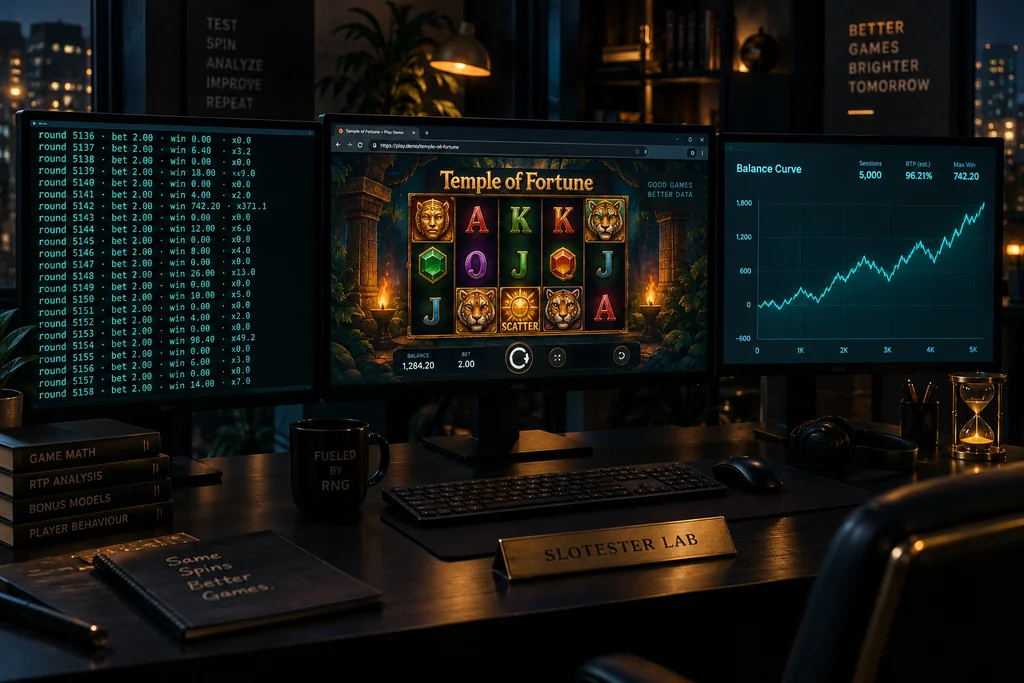
What is Slotester?
Slotester (slotester.com) is an English-language slot testing lab. Its software plays online slots on the studios' own demo servers, logs each round and turns the log into a review with measured RTP, a 95% confidence interval, hit rate, bonus frequency, bonus buy value, dry runs and drawdown. A human editor checks every figure against the log before a review is published.
The site is not a casino and takes no bets. The playable demos on its pages load from the studios' servers, and the lab states plainly that its numbers describe recorded samples, not future results. By 28 September 2026 it had published 102 tests covering 1,320,000 logged rounds, 5,200 bonus purchases and 8,193 naturally triggered bonuses.
The rig: a Python harness that speaks the server's language
At the core of the lab sits what the site calls an AI test rig. In practice it is a test harness written in Python that talks to a game server the way the game client does. It opens a demo session, receives a session key, the paytable, the bet levels and the RTP profile the server reports for that build, then sends spin requests one by one and follows each round to the end: cascades, respins, free spins and the final collect. Nothing is simulated locally and no random number generator is emulated, so every logged round is a real result produced by the provider's own math.
The same rig drives a real Chrome window when screenshots and video are needed, and it drafts the first version of every review from the log. That draft is where the "AI" in the tagline lives. Deciding what the numbers mean, and whether a run is fit to publish, stays with the editor.
Five demo protocols so far
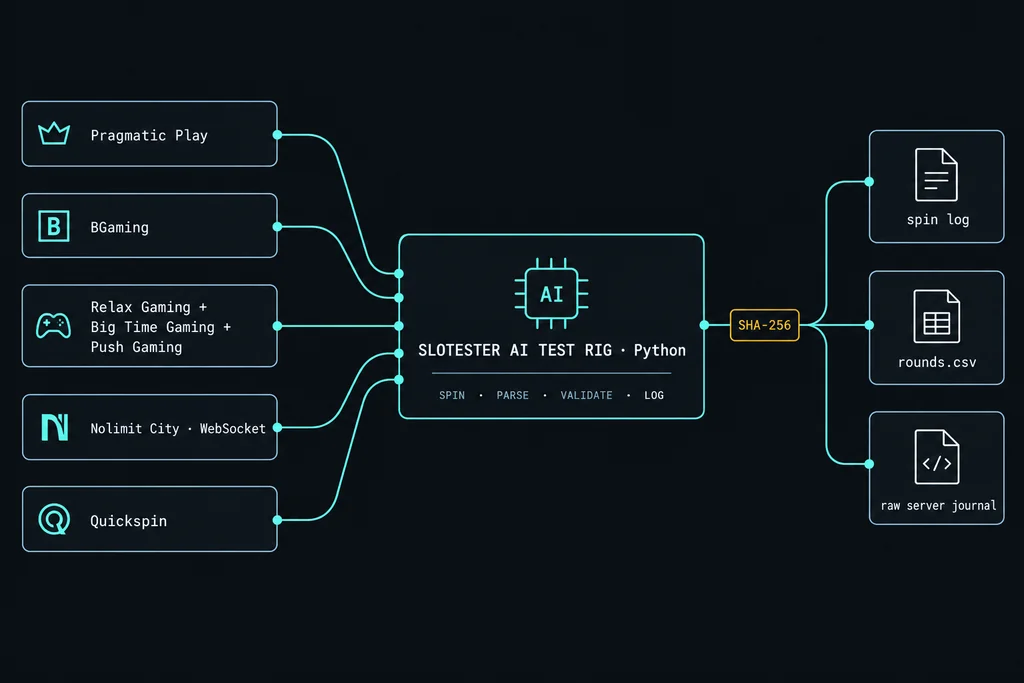
Every studio's demo server speaks its own dialect, so each one needs its own adapter. The lab's public timeline lists them in the order they were added:
| Protocol | Added | What stands out |
|---|---|---|
| Pragmatic Play | 3 Sep 2026 | The first protocol: session, spins, cascades, free spins, purchases and media capture |
| BGaming | 8 Sep 2026 | One JSON request per round, three purchase levels, max-win odds published in the game config |
| Relax Gaming | 8 Sep 2026 | A whole round, respins included, arrives in one response; partner studios such as Big Time Gaming and Push Gaming run on the same server |
| Nolimit City | 27 Sep 2026 | Rounds travel as encoded frames over a WebSocket connection |
| Quickspin | 27 Sep 2026 | A whole round, free spins included, comes back in one response |
Which studios appear on the site depends only on which protocols the rig can read. The lab has no agreements with game studios: they do not pay for tests, cannot commission them and never see a review before it is published.
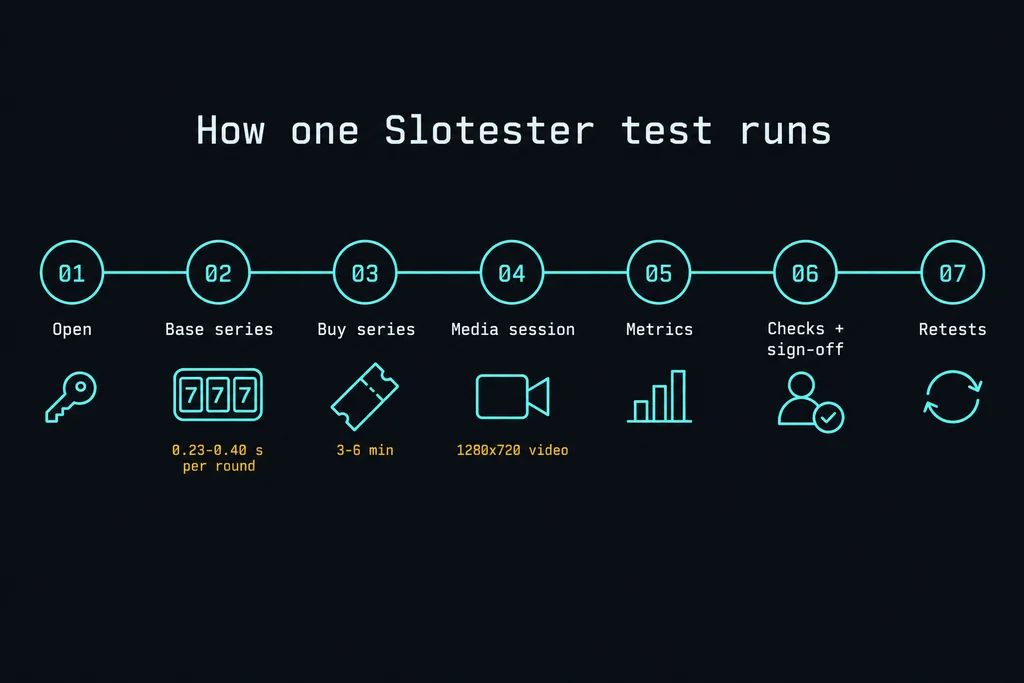
From session to published page in seven steps
- Open. The rig requests the official demo build and stores the server's own paytable and RTP profile.
- Base series. One uninterrupted session of ordinary spins at a fixed bet of 2.00 demo units. A round takes 0.23 to 0.40 seconds, depending on how many cascades it produces.
- Buy series. Where a game sells its feature, a series of purchases at the listed price in the same session, usually three to six minutes of work.
- Media session. A real browser plays the same build, and the bonus round is captured from the tab at 1280x720 with sound.
- Metrics. RTP with an approximate 95% interval, hit rate, payout distribution, dry runs, drawdown, bankroll survival and buy value, all computed from the log.
- Checks and sign-off. Automated checks run first, then the editor reads the draft against the log.
- Retests. Later the same game is run again as a fresh session, and every run stays on the page.
A standard run takes about an hour of rig time. Games without a buy button can need up to an hour more, because the media session keeps spinning until the feature triggers on its own, so the bonus video is always real.
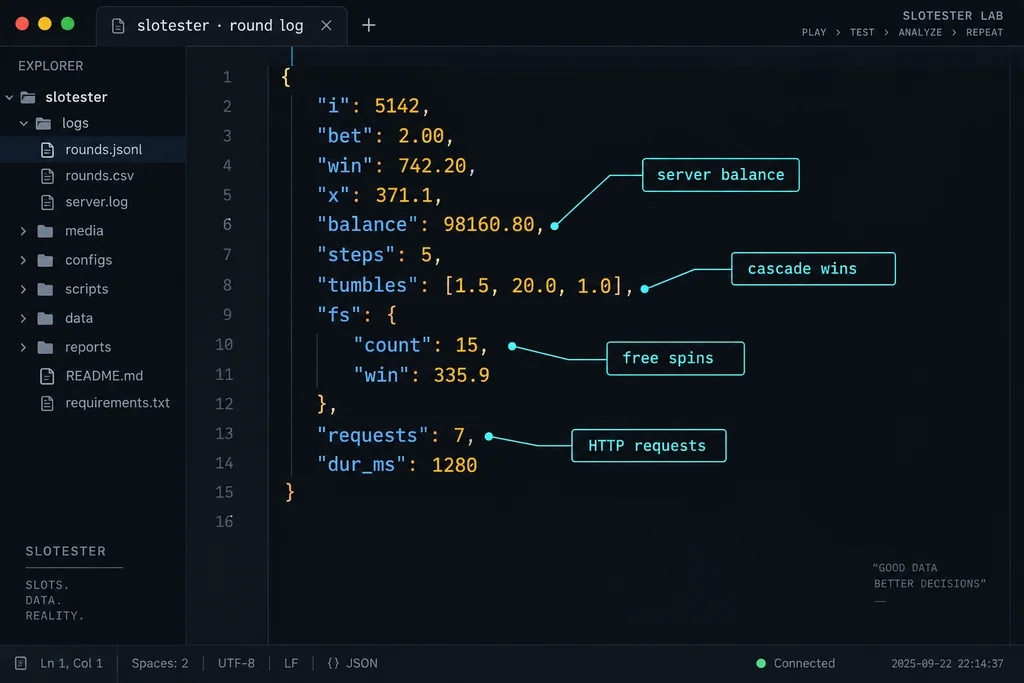
What one round looks like in the log
Internally each round becomes a single JSON line. The fields are documented on the lab's How we test page: the round number; bet, win and win as a multiple of the bet; the server balance after the collect; how many server responses it took to finish the round; the win of each cascade step; a free-spin block with count, total and per-spin multipliers; the symbol grid of the first screen; and the number of HTTP requests with the time in milliseconds. The archive also keeps the raw requests and responses and a separate purchase journal.
Balance reconciliation and the other checks
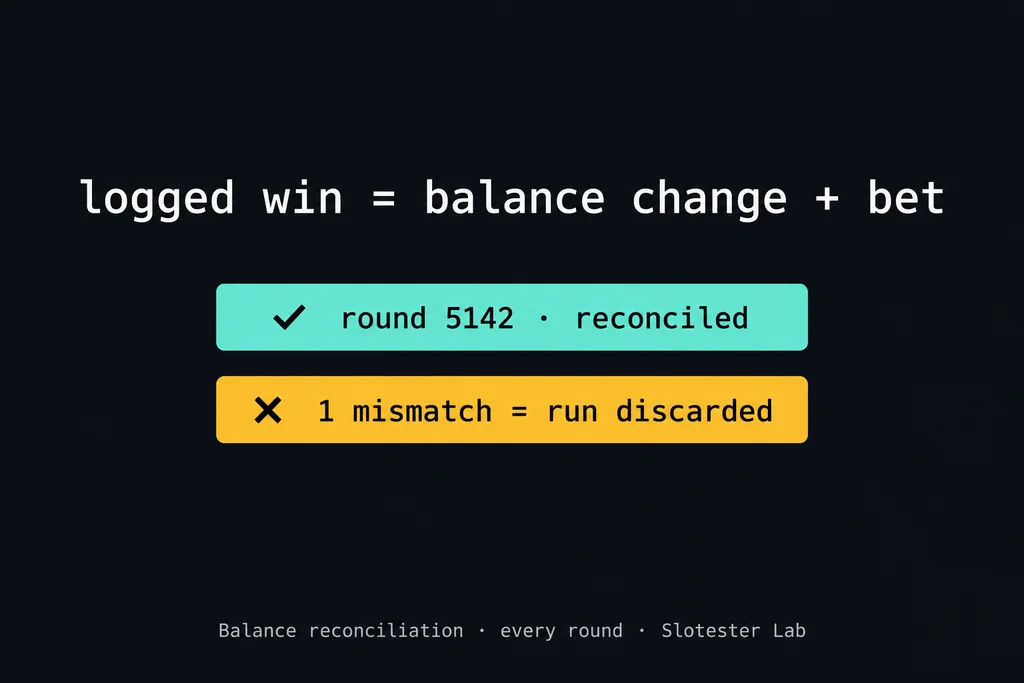
The most important check is also the simplest. For every round, the logged win must equal the change in the server balance plus the bet. If a single round fails, the protocol was misread and the whole run is thrown away. The rule arrived early: after the lab took ten games live in one night on 4 September 2026, reconciliation became mandatory and was applied retroactively to every earlier run.
More checks follow. Free-spin totals are taken from the server's own end-of-feature fields and must match the per-spin sum. Every number in the text is looked up in the run before the page is built. Each new review is compared with every published one to catch recycled sentences, and the page is rendered on a desktop and on a 390-pixel phone. Only then does the editor read the draft.
Open data, closed rig
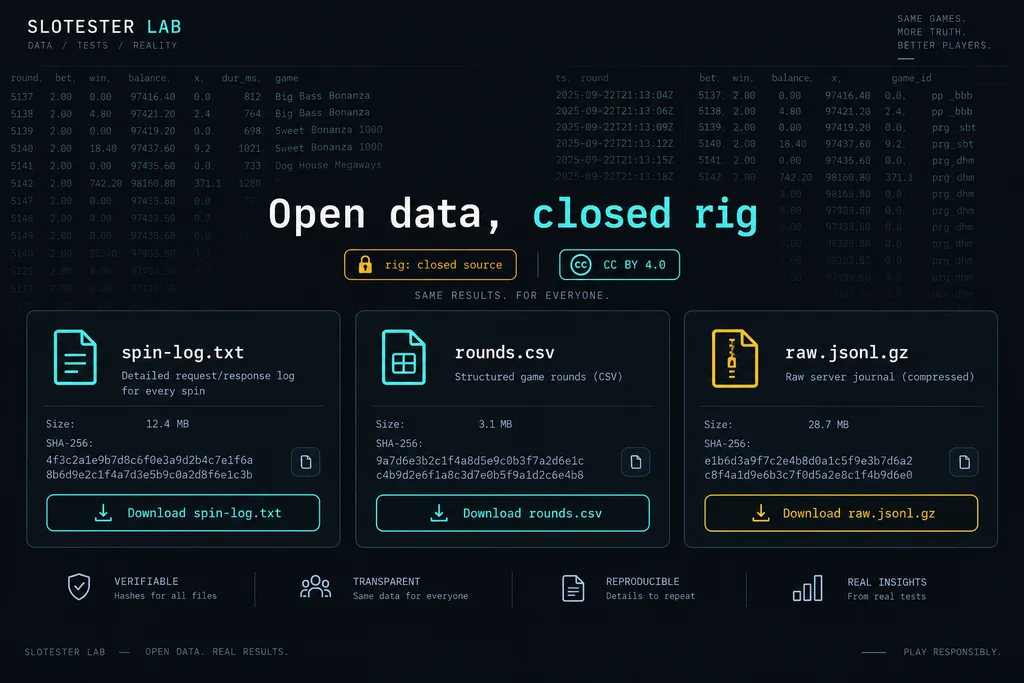
Slotester publishes its evidence and keeps its tooling private. Every run in a review's Test record comes with its files: a readable TXT spin log, a CSV of ordinary rounds and gzipped JSONL journals of rounds, purchases and raw server traffic, each with a SHA-256 checksum. The same files are described in schema.org Dataset markup on the review page and licensed CC BY 4.0, so the logs can be reused with attribution. The rig itself stays closed source, on the reasoning that a published rig is a rig that can be gamed.
Anyone can repeat the core calculation. Measured RTP is the sum of wins divided by the sum of bets over the ordinary paid rounds, and the How we test page includes a one-line Python command that does exactly that on the downloaded CSV. For a retested game, joining the CSVs of all runs reproduces the pooled figure shown on the test card. Sugar Rush makes a tidy exercise: its three runs returned 90.80%, 93.15% and 107.01%, and concatenating the three files rebuilds the pooled Sugar Rush RTP of 96.99% over 30,000 rounds, against a declared 96.50%.
The publishing layer
The public side runs on deliberately plain technology. The site is built on WordPress with a custom theme styled like a lab console, and most of what a reader sees is generated from run data rather than typed by hand: the test card, the balance and distribution charts drawn as inline SVG, the list of purchased tickets and the per-run plates in the Test record. Review pages carry structured data for the review, the FAQ, the bonus video and the dataset. The four rankings, Best RTP, Best Bonus, Max Win and Free Spins, sort games by measured values only, and the articles in the Research section recalculate their tables and charts from the current test set each time a page is opened, so every quoted figure carries the date of the data behind it.
The metrics, plus one unit of its own
Most metrics are familiar: measured RTP, hit frequency, the longest run of losing spins, the deepest drawdown in bets and whether a bankroll of 50, 100 or 200 bets would have survived the session. The interval uses a normal approximation, the mean plus or minus 1.96 standard deviations divided by the square root of n, and the lab warns that rare large payouts make it imperfect. One unit is its own invention: bHz, naturally triggered bonuses per 1,000 ordinary rounds. A game at 5.2 bHz hands out a feature about every 192 rounds, and because bHz is a rate, games tested over different numbers of rounds can be compared directly.
What the data says so far
Across 102 tests the average measured return is 96.1% against an average declared figure of 96.45%. Fifty-nine tests finished below their declared value and forty-three above, close to the split expected from correctly declared games and finite samples. In 96 of 102 tests the declared figure sits inside the measured 95% band, a result the lab reports without claiming it proves fairness. The spread between single runs is wide, from 66.7% on Tombstone R.I.P to 137.8% on Top Dawg$. Natural bonuses arrive once every 159 rounds on average, and bought features returned 0.92x of their price for the average game.
Frequently asked questions
Who runs Slotester?
The site publishes under one name, Slotester Lab, instead of invented reviewer profiles. Software runs the tests; one responsible editor signs off every review and answers corrections sent to [email protected].
Does Slotester use simulations?
No. Every round in a log is a response from the studio's official demo server; no random number generator is emulated.
Is the rig open source?
No. The logs are public and verifiable with checksums, while the software that produces them is not published.
How does the site make money?
Through casino affiliate links shown only next to a game's demo and marked as sponsored. Partners cannot change a measured number, a verdict or a ranking.
