

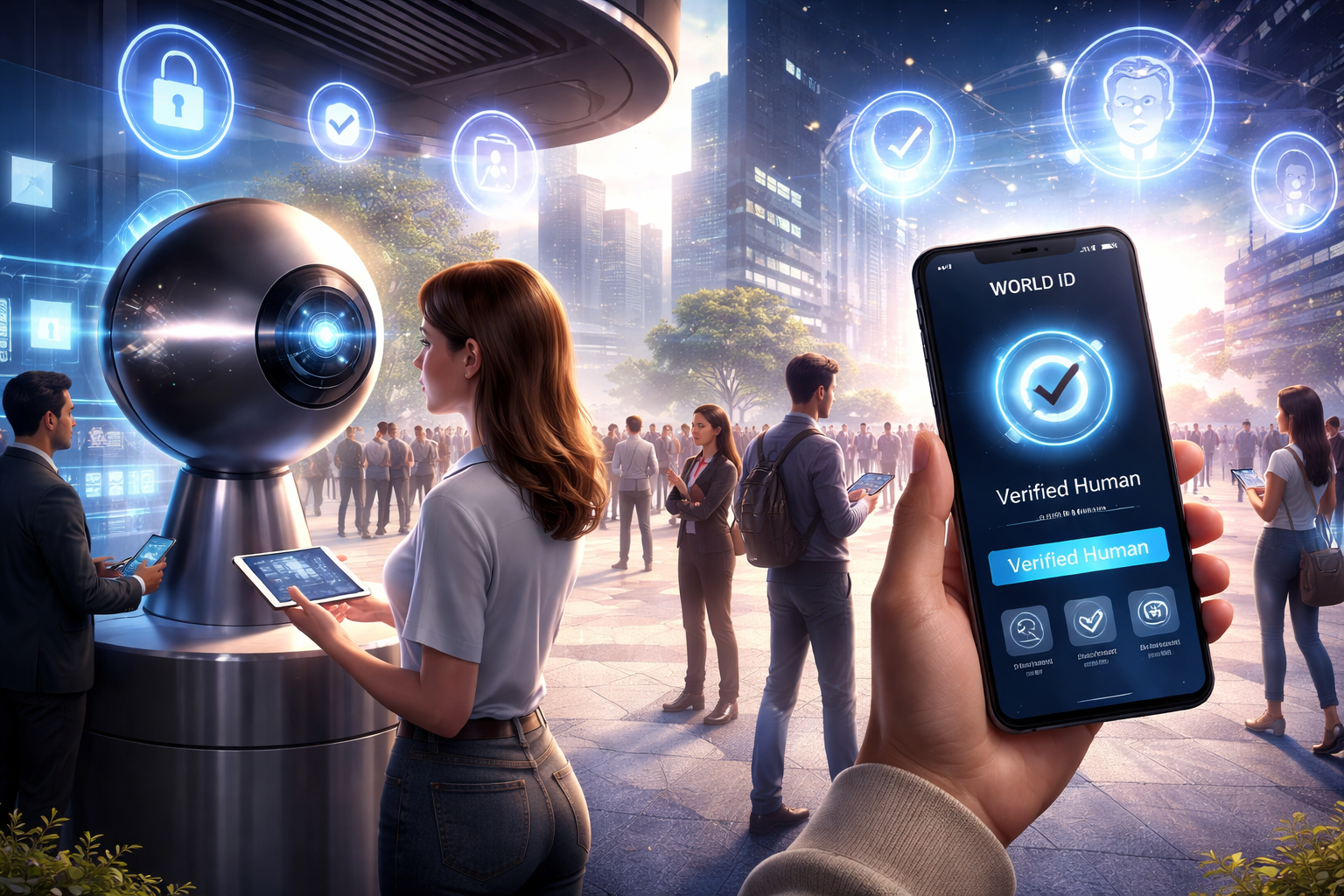
As we move through 2026, the digital world is facing a crisis of reality. With AI agents now capable of mimicking human speech, writing perfect code, and even generating high-fidelity deepfake videos in real-time, the internet is becoming a crowded room where you can’t tell who’s actually breathing.
This “dead internet” theory—the idea that most online activity is just bots talking to other bots—is exactly why the World network has shifted from a niche crypto project into essential global infrastructure.
Formerly known as Worldcoin, the rebranded “World” initiative isn’t just about a token anymore; it’s about a “Proof of Personhood.”
It’s the only system currently scaling a way to prove you are a unique, real human being without forcing you to hand over your name, address, or government ID to every app you visit.
The Orb: The Physical Bridge to Digital Trust
The centerpiece of this entire operation is a piece of hardware that looks like it was pulled from a sci-fi set. The Orb is a high-tech biometric imaging device designed by Tools for Humanity.
In a world where AI can bypass almost any software-based “I am not a robot” test, the project relies on the one thing a bot can’t fake: the complex, random patterns of a human iris.
By 2026, the technology inside the device has reached a new peak. The latest “Orb 2.0” models, powered by Nvidia’s Jetson chipset, offer five times the processing power of the original versions.
This speed isn’t just for convenience; it enables Personal Custody, a massive privacy win. When you look into the device, it processes your iris pattern locally, creates a mathematical “iris code,” and then deletes the actual image from its memory forever.
You walk away with a World ID on your phone—a digital passport that proves you’re human while keeping your actual identity anonymous.
The Trust Layer: Rebuilding Digital Society
Joining the network isn’t just about the hardware; it’s about what that biometric verification unlocks in a digital economy overwhelmed by synthetic data. By 2026, the most fascinating evolution isn’t a specific app—it’s the emergence of a parallel “Human Web.”
We are seeing a massive shift where the internet is fracturing into two layers: the chaotic, bot-filled public square, and verified, human-only spaces. This foundational trust layer is reshaping how society operates online:
- The Authenticity Premium: In the gig economy and creative industries, verifiable human output is now highly sought after. Freelance platforms, news syndicates, and digital marketplaces are using proof of personhood to guarantee to clients that the code, art, or analysis they are buying was generated by a human mind, not secretly churned out by an undercover AI agent.
- Sybil-Proof Communities: The age-old problem of online manipulation has finally been solved. Decentralized organizations, massive multiplayer gaming servers, and even local civic platforms use the network to enforce a strict “one person, one vote” policy. This completely neutralizes the threat of AI bot-swarms that used to manipulate online polls, artificially inflate trends, or disrupt community governance.
- Zero-Knowledge Commerce: The e-commerce sector has adopted this layer to combat the massive surge in synthetic fraud. Users can now engage in high-trust digital transactions—like securing limited-edition goods, booking scarce reservations, or signing digital agreements—proving they are a unique, legitimate buyer without ever exposing their real name, email, or credit score to the merchant.
Why It’s Actually Interesting to Use?
The reason millions are heading to the find-orb map on the official site isn’t just curiosity—it’s utility. In 2026, being “verified human” comes with tangible perks that go beyond tech ideology:
- Financial Inclusion: For many in emerging markets, a World ID is the first time they’ve had a globally recognized, secure way to participate in the digital economy without needing a traditional bank.
- Deepfake Protection: The new “World ID Deep Face” feature allows you to verify your identity during video calls, ensuring the person on the other end knows they aren’t talking to an AI-generated clone.
- The “Human Dividend”: The project continues its mission of equal distribution, providing regular token grants to verified humans. It’s the closest thing we currently have to a global, AI-funded Universal Basic Income experiment.
The Bottom Line: Human-Centric Innovation
The 2026 World network is a response to a world where AI is everywhere. It’s about ensuring that as technology moves forward, humans don’t get pushed to the sidelines.
By visiting an verification point and securing your ID, you aren’t just joining a platform; you’re helping build a “Real Human Network” that protects the value of being a person in a digital age.
