

The Finals end in June, the confetti gets swept up, and for a long time that was the signal to move on. Basketball went quiet until October.
Open your phone in July now and you’ll find the opposite. Someone is ranking the draft class. Someone else is arguing about a free-agent signing. A rookie’s first pro dunk is being replayed from four angles.
The sport doesn’t have an off switch anymore. Social media is the reason, and it has changed how fans connect with each other as much as how they follow the game.
The season used to have an off switch
Before social platforms, summer was thin. You got a few newspaper pieces about trades, a draft night broadcast, and maybe a pickup game with your friends. Then you waited.
Conversation lived where you lived. It happened at the barbershop, at school, at the office. If your friends moved on to baseball or didn’t care that month, the debate simply paused.
That pause is gone. Whatever you want to argue about, there’s a thread, a group chat or a comment section already going, at any hour, in any time zone.
Now the offseason has its own calendar
The strange part is how structured the “quiet” months have become. Each stretch has its own storyline, and fans plan around them:
- Draft night. Fans react to every pick in real time, including players they only know from college highlights.
- Free agency. A few days of rumors, reactions and “who’s next” guessing that rivals the playoffs for attention.
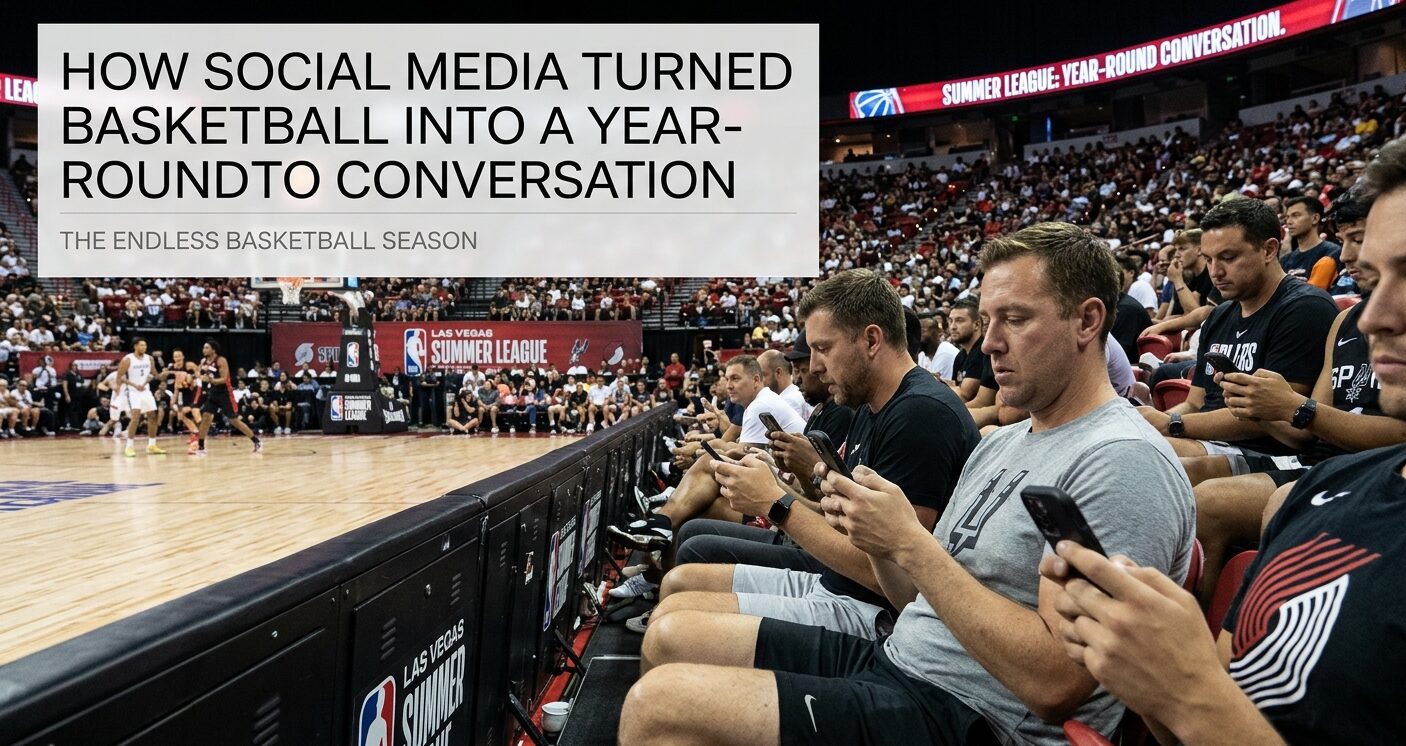
- Summer League. Exhibition basketball that still draws crowds, because it’s the first look at new players.
- Schedule release and video game ratings. Late-summer rituals where fans check their team’s opening week and fight about player ratings.
- Media day and training camp. The last stretch before the season, full of workout clips and “best shape of his life” claims.
There’s hardly a week where nothing is happening. The calendar fills itself in because fans keep showing up for it.
Summer League is the proof
Summer League is a good test case. The games are exhibitions. Most stars aren’t playing. Under older rules of fandom, almost nobody would care.
Yet the numbers keep climbing. The NBA reported that the 2023 Summer League opening weekend, driven by Victor Wembanyama’s debut, delivered 300 million video views across NBA social and the NBA App. Wembanyama’s debut alone accounted for 72 million of them.
The 2026 event went further. Newsweek reported that Las Vegas set new records for in-person attendance (156,000, a 12% jump over the 2018 record) and merchandise sales, and that the championship game averaged 676,000 viewers on ESPN, up 61% from the year before.
Part of that is the talent. The top of the 2026 draft class was widely seen as unusually strong, and fans wanted to see it. But social media is what made the interest visible before anyone bought a ticket. Clips of rookies spread first, and the audience followed the clips.
What keeps people talking when nothing is happening?
If there are no games, what are millions of people discussing? A few reliable things:
- Rumors and speculation. Every trade idea is a conversation starter, even the ones that never happen.
- Rankings and debates. Top-100 lists, all-time teams and “most underrated” arguments don’t need a game to be played. They only need an opinion.
- Player-made content. Workout videos, podcasts and behind-the-scenes clips let players talk to fans directly, without waiting for a postgame interview.
- Nostalgia. Old games and classic highlights resurface constantly. A 20-year-old clip can feel brand new to a fan who wasn’t watching then.
- Trivia and lists. Evergreen questions fill the gaps. Basketball Loop’s piece on the shortest NBA players ever, led by Muggsy Bogues at 5’3″, is the type of thing people share in the middle of July because it needs no context and starts an argument right away.
Notice what these have in common. None of them depend on a live result. They depend on a community that wants to keep talking.
Who actually benefits?
Fans get something real out of this. A group that argues together all year becomes a kind of club. People who live far from any arena, or whose friends don’t follow the sport, can find others who care just as much.
Players benefit because they build audiences that don’t depend on a broadcast. Teams benefit because a fan who stayed engaged through July is more likely to buy a ticket or a jersey in October.
And smaller publishers get a steady stream of topics. The offseason used to be a content desert. Now it’s one of the best times to publish, because there’s an appetite and less competition from live games.
The downsides nobody likes to mention
A year-round conversation has costs, and fans feel them even if they don’t say so:
- Burnout. Following the sport for twelve months is tiring. Some fans arrive at the playoffs already worn out.
- Rumor fatigue. Most speculation never turns into anything, but it all demands your attention while it’s live.
- Louder arguments. Hot takes travel faster than careful ones, so the loudest voices set the tone.
- Less quiet. There used to be a natural time to step away and come back refreshed. That window has shrunk.
How to stay connected without burning out?
You don’t have to follow everything to enjoy the conversation. A few habits help:
- Choose your moments. Pick two or three offseason events you actually care about, such as the draft and Summer League, and let the rest pass.
- Find a small group. A group chat with five friends beats a comment section with five thousand strangers.
- Wait on rumors. If a trade matters, it will still matter after it’s confirmed.
- Take a real break. A week or two offline in the summer is a good idea, not a failure.
- Follow people who add something. Accounts that teach you a thing or make you laugh are worth keeping. The ones that only make you angry are not.
If you run a community or a content channel
The offseason is a chance to build trust, since you aren’t competing with the games themselves. These steps tend to work:
- Plan around the calendar. Draft, free agency, Summer League and the schedule release all give you a built-in hook.
- Publish evergreen pieces. Lists and explainers keep earning attention months later, while news posts fade in a day.
- Ask a question people can answer. Comment sections grow when the first sentence invites an opinion.
- Reply to people. A community forms when members see that someone is listening.
- Know when to stay quiet. Not every rumor needs a post. Waiting for confirmation protects your credibility.
The conversation is the product
For a long time, basketball was something you watched. Now it’s also something you talk about, with people you may never meet, whether or not a game is on.
That’s a big change in what it means to be a fan. The game still matters most. But a lot of the connection that fans feel happens in the weeks between games, in threads and chats and quick replies at 11 p.m. in July.
Social media didn’t invent that love of arguing about basketball. It just gave it somewhere to live all year.
