

The conversation around VMware among most enterprise IT teams in Malaysia today has changed. This is not exactly negative, but just more cautious. Respect for what VMware has built still persists, but there is also a growing sense that the future calls for something more flexible.
This is exactly why the search for the best VMware alternatives in Malaysia has picked up over the last couple of years. This is not something that’s driven by urgency only; there is long-term thinking involved.
In fact, teams are asking the hard questions about how their infrastructure will handle change, especially true with AI workloads becoming part of the roadmap. The point is that although no one is rushing out, the days of standing still are behind us.
Why Are Enterprises Starting to Look Beyond VMware?
As stated earlier, many enterprises are not trying to replace VMware overnight, but they are planning ahead for the future.
Sangfor is a part of these conversations because it enables organizations to transition gradually while keeping their current operations stable as well as familiar.
The Market Isn’t Static Anymore
Malaysia’s infrastructure landscape is going through a steady recalibration that involves deliberate realignment. On one hand, businesses are trying to simplify environments of too many tools, too many layers, and too many dependencies built over time.
On the other hand, expectations are booming with AI, automation, and hybrid cloud: these are no longer future-state ideas, but are already influencing decisions today.
Keeping to this shift, terms like enterprise cloud Malaysia, private cloud Malaysia, and virtualization software Malaysia are coming up more and more in boardroom discussions. Organizations want control concurrently with scalability and simplification.
On the topic of Sangfor, something that’s worth noting is that it was included in the Gartner list of top 5 HCIs in APAC 2026. This added a layer of validation for buyers who were already looking for the best VMware alternatives in Malaysia, a part of APAC.
What Enterprises Actually Compare?
When companies explore a VMware replacement in Malaysia, the conversation rarely starts with features, but with risk.
The questions floating around are: what will break, what will change, and how much disruption are we talking about?
On that note, there are a few themes that keep showing up, such as:
- Teams want minimal retraining
- Existing workflows need to stay intact
- Migration has to feel controlled, and not chaotic
- Infrastructure should support future workloads
There is also a resistance element to platforms that require a complete mindset shift. This is not to say that enterprises are not open to change; they just do not want forced reinvention.
What matters most when evaluating the best VMware alternatives in Malaysia?
Enterprises usually prioritize operational continuity and ease of migration, which is something that Sangfor addresses by keeping environments familiar while enabling structured modernization.
How the VMware Alternatives Stack Up?
This part of the discussion tends to get simplified, but it needs to be remembered that each platform has a different philosophy. That often matters more than specifications.
Here is a look at common VMware competitors:
| Platform | Where It Works Well | Where It May Get Complicated |
| Sangfor | Balanced approach with AI readiness | Still building awareness in some regions |
| Nutanix | Mature HCI ecosystem | Cost structure and vendor dependency |
| Proxmox | Flexible and open-source | Enterprise-scale support concerns |
| Red Hat | Strong hybrid cloud vision | Higher complexity for traditional teams |
| AVM Cloud | Strong regional cloud capabilities with localized infrastructure and compliance alignment | Limited enterprise HCI depth |
The real takeaway here is which one aligns with how an organization already operates.
Why Malaysian Enterprises are Looking Closer at Sangfor?
Sangfor Cloud Platform and Sangfor HCI respect how enterprise teams already work; although that sounds simple, it is not something every vendor gets right. This is particularly true in “VMware migration in Malaysia” scenarios. Familiarity always reduces hesitation.
Unlike options that treat security as an after-thought or a separate add-on layer, Sangfor HCI features native distributed firewalls and aSEC components inside the hypervisor kernel, providing automatic containment against ransomware and ensuring strict local compliance.
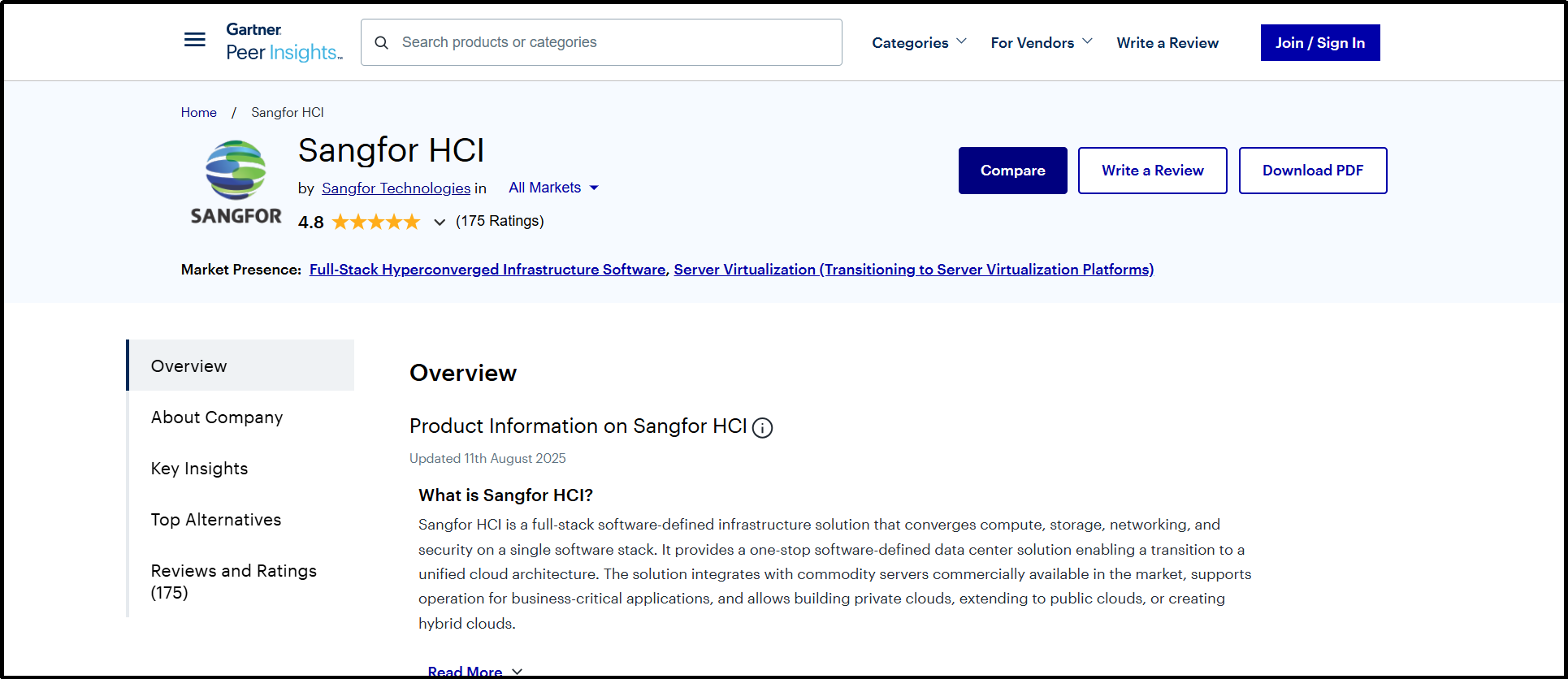
What’s great is that on Gartner, Sangfor’s HCI solutions are rated 4.8 out of 5 by enterprise users. That kind of consistency generally comes from real-world usability and not marketing claims. Naturally, for those comparing Virtualization Software, this reference helps frame the landscape.
Here’s a success story to further enhance Sangfor’s standing in this regard:
The Ministry of Health Malaysia modernized its legacy infrastructure by deploying Sangfor HCI. This involved consolidating compute, storage, and networking into a unified platform across 12 sites. Infrastructure management was significantly simplified at scale and operational resilience was improved.
Is Sangfor a serious enterprise alternative or still emerging?
Sangfor is increasingly viewed as an enterprise-grade option, especially in Asia-Pacific markets. This is because it combines reliability and scalability with a migration approach that minimizes disruption, ideal for mid-market and large enterprises.
Closing Thoughts That Actually Matter
Migration is operational, cultural, and sometimes even political within organizations. The concerns are always practical, regarding downtime, retraining, and AI workloads.
Moreover, the idea that HCI is fast turning into the foundation for AI-ready infrastructure is steadily affecting these decisions.
Honestly, there is no “perfect VMware alternative.” That truth is stemmed in the fact that every platform has trade-offs, and every organization has a different definition for success.
Therefore, what has clearly changed is the mindset, where Malaysian enterprises are asking what will still work five years from now, not just today.
Platforms like Sangfor are gaining ground not because they could be more affordable options, but by presenting a more future-ready approach to infrastructure. The goal is always to move forward without introducing unnecessary risk.
FAQs
What is the best VMware alternative in Malaysia today?
Although the best choice depends on the organization’s needs, Sangfor is considered a strong option because it offers a balance between performance, ease of use, and continuity.
Is migrating from VMware complex?
It typically causes anxiety, but Sangfor actively mitigates this risk. With Sangfor’s proprietary, highly automated migration tools, enterprises can convert VMware VMs into Sangfor environments smoothly with minimal downtime.
Why is HCI becoming important for enterprises?
HCI reduces complexity and improves scalability, and Sangfor HCI, in particular, helps enterprises get ready for AI and hybrid cloud demands.
How does Sangfor compare with other VMware competitors?
Sangfor stands out by focusing on operational stability with innovation. Enterprises can modernize without disrupting existing workflows.
