

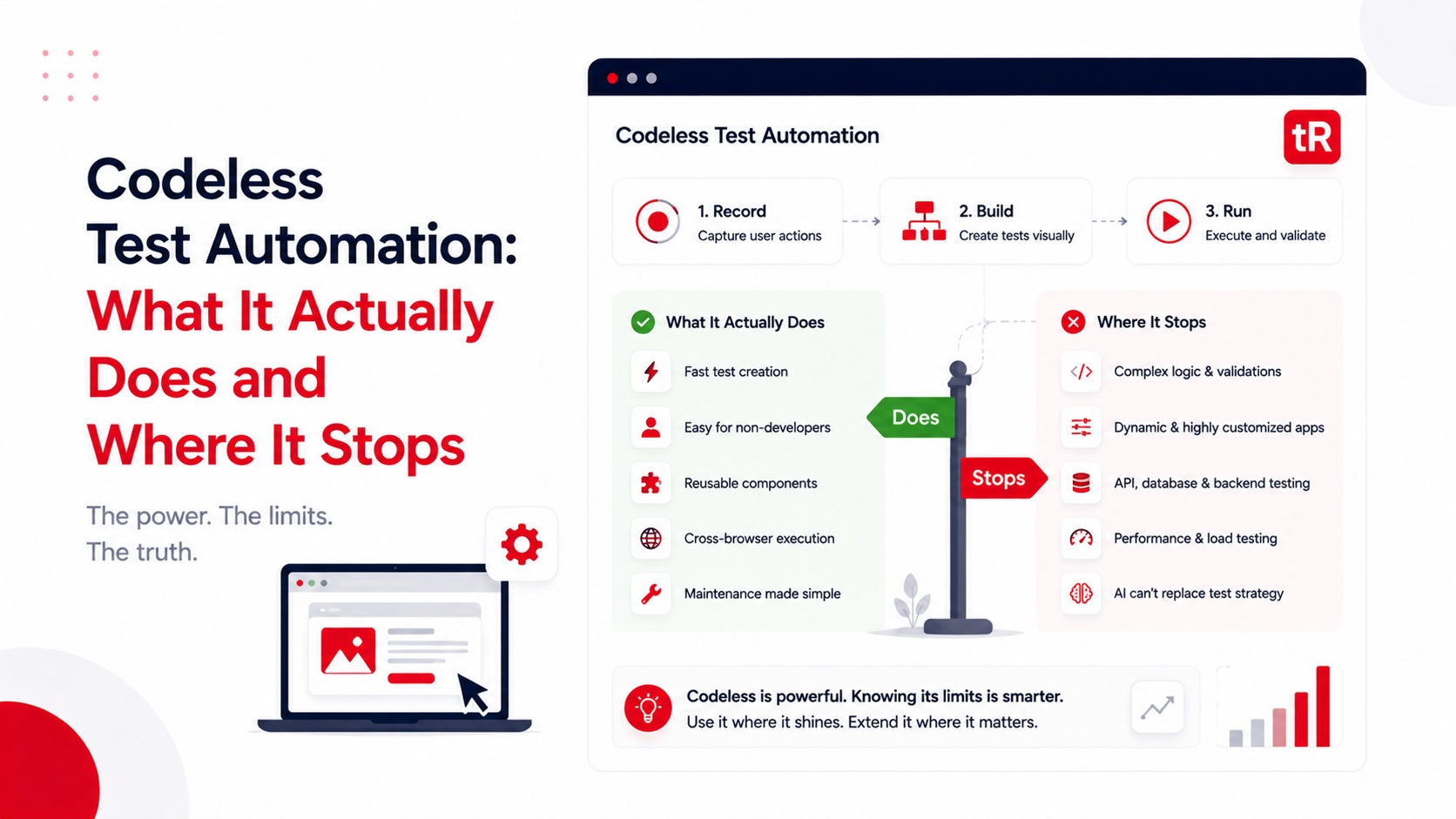
Codeless testing is having a moment, and the pitch is easy to oversell. Write tests without code, the story goes, and your automation problems disappear.
I advocate for low-code QA, so I want you to adopt it, but for the right reasons. That means being honest about what “codeless” really means, who it fits, how it handles genuine complexity, which tools are worth knowing, and the part most vendors skip: where it hits a ceiling.
What “Codeless” Really Means
Codeless test automation lets you create and run automated tests without writing traditional programming code, using plain language, visual builders, recorded actions, or AI generation instead.
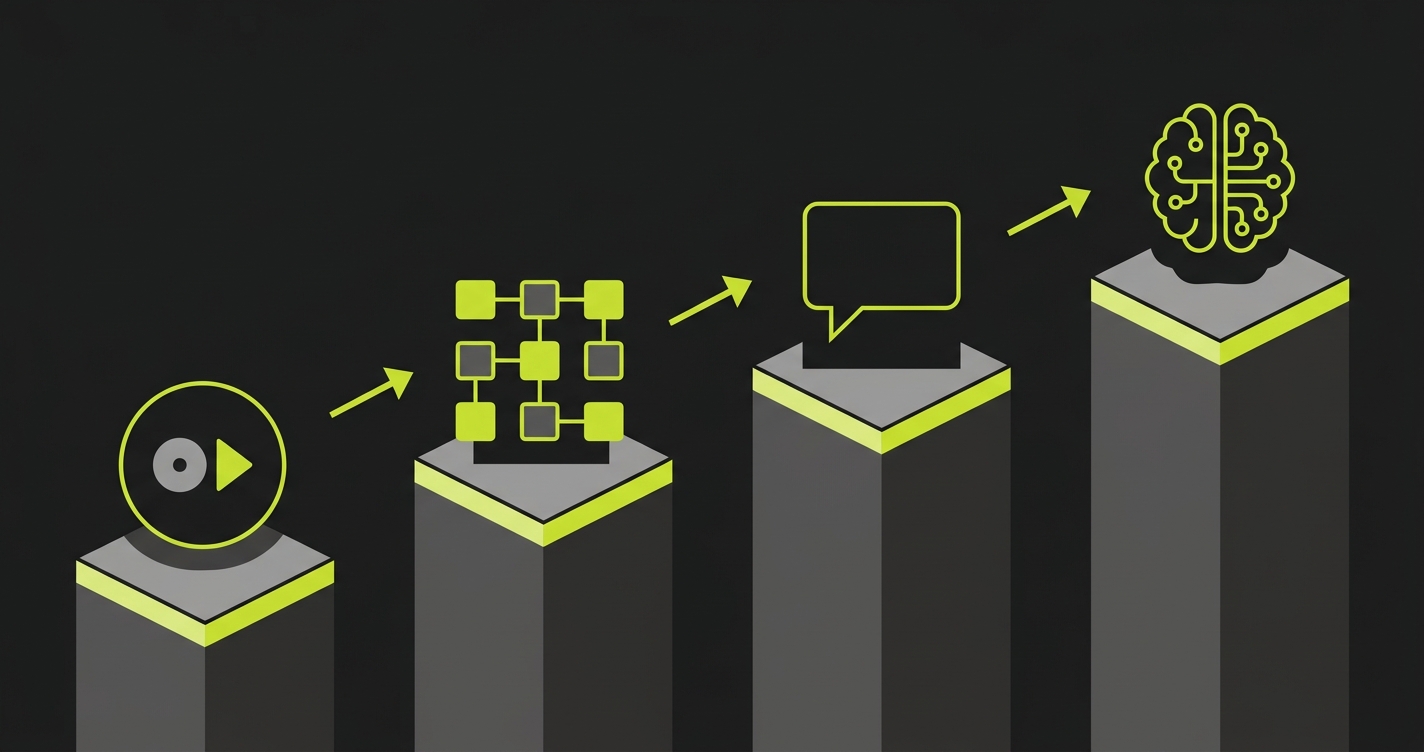
That definition hides a wide quality range, because “codeless” now comes in four very different flavors:
- Record-and-playback: the tool captures your clicks and replays them. Easiest to start, most fragile to keep.
- Visual or model-based builders: you assemble tests from blocks or a flow diagram.
- Natural-language authoring: you describe the test in plain English, and AI interprets the intent.
- AI generation and agents: the tool observes your app or real user traffic and generates tests for you, often self-healing them over time.
These are not equals. Record-and-playback is the brittle old end. Natural-language authoring and AI agents are the modern end. Lumping them together is how “codeless” earns its mixed reputation.
Who Codeless Is (and Isn’t) For
Codeless is genuinely transformative for the right people. It fits manual QA testers upskilling into automation, teams without dedicated automation engineers, and citizen developers or product-side colleagues who understand the application deeply but do not code.
It is not the right fit everywhere. Teams needing low-level control over every interaction, performance, and load engineering, or bespoke protocol work will hit friction fast.
And here is the honest caveat an advocate owes you: codeless removes the coding barrier, not the testing-skill barrier. You still need to know what to test, where the edge cases hide, and how to design a suite that catches real bugs. A tool that lets anyone write a test does not make anyone a tester.
How Codeless Tools Handle Complex Flows
Simple happy-path clicks are easy for any tool. The real differentiator is complex flows, multi-step journeys, dynamic data, two-factor authentication, file uploads, and conditional logic.
This is exactly where record-and-playback collapses, and modern AI tools pull ahead, because they work from intent rather than a rigid recording. A plain-English test can express real logic without a line of code:
login with “[email protected]” and password
add “Wireless Headphones” to the cart
apply coupon code “SAVE10”
complete checkout using the saved card
check that the page contains “Order Confirmed”
No locators, no scripting, but genuine logic, readable by anyone on the team. That is the leap from recording a test to authoring one, and it is the whole reason the modern codeless tools have outgrown the ones that came before them.
The Codeless AI Tools Worth Knowing
The category is broad, so match the tool to your needs rather than chasing a single winner. In plain English, natural-language tier: testRigor, as an AI testing tool, leads you to write tests in plain English; generative AI builds and maintains them, and it spans web, mobile, desktop, and API from one place. Around it sits a wave of newer AI-native tools, each with a distinct approach:
| Tool | Authoring style | Skill needed | Complex-flow handling | Main limit |
| testRigor | Plain-English (NLP) + generative AI | Non-technical + test-design sense | Strong for web E2E, mobile, desktop, API | Cloud-based; new mental model |
| Checksum | AI generates from real user sessions; outputs Playwright | Low to author; some review | Good for web E2E; auto-heals via PRs | Web/Playwright-focused; needs review |
| Octomind | AI agents auto-discover journeys, generate Playwright | Very low; ~5-min setup | Good for web E2E; self-healing | Web only; best for small, fast teams |
| Keploy | Records real API traffic (no code changes); generates tests + mocks | Developer-oriented | Strong for API/integration; not UI | Backend/API focus, not UI or E2E |
| TestGrid CoTester | Conversational, from Jira stories/specs; human-in-loop | Low; non-technical friendly | Good for enterprise domains, self-healing | Enterprise-oriented |
A useful way to read that table is by need:
- Best for non-coders authoring across web, mobile, and API: a plain-English tool like testRigor.
- Best for auto-generating web E2E tests from real usage: an agent tool like Checksum or Octomind.
- Best for API and integration testing without touching code: Keploy.
- Best for enterprise, domain-heavy testing with human oversight: CoTester.
Where Codeless Hits Its Limits
No honest advocate skips this part. Codeless has real ceilings:
- Deep debugging. When a failure is subtle, code gives you more control over inspection than most codeless tools expose.
- Highly custom scenarios. Bespoke protocols and unusual integrations can outrun what a codeless tool supports.
- Performance and load testing. A different discipline entirely; functional codeless tools are not built for it.
- Portability and lock-in. This one cuts both ways. Some tools like Checksum and Octomind output standard Playwright code you own, so lock-in is low. Others keep tests in a proprietary cloud. Check which one before you commit to a large suite.
- Skill, again. The tool will never tell you what is worth testing.
The mature view is not “codeless versus code.” It is that codeless is better for a different job, and a different person. Most healthy teams end up with a mix.
The Bottom Line
Codeless test automation is real leverage. It brings manual testers into automation and removes the coding barrier that kept them out. The modern natural-language and AI-agent tools handle far more complexity than the record-and-playback era ever could.
Adopt it clear-eyed, though. It removes the code, not the craft, and it has genuine limits. Match the flavor to your team, keep code within reach for the edges, and codeless will earn its place without the overselling.
