

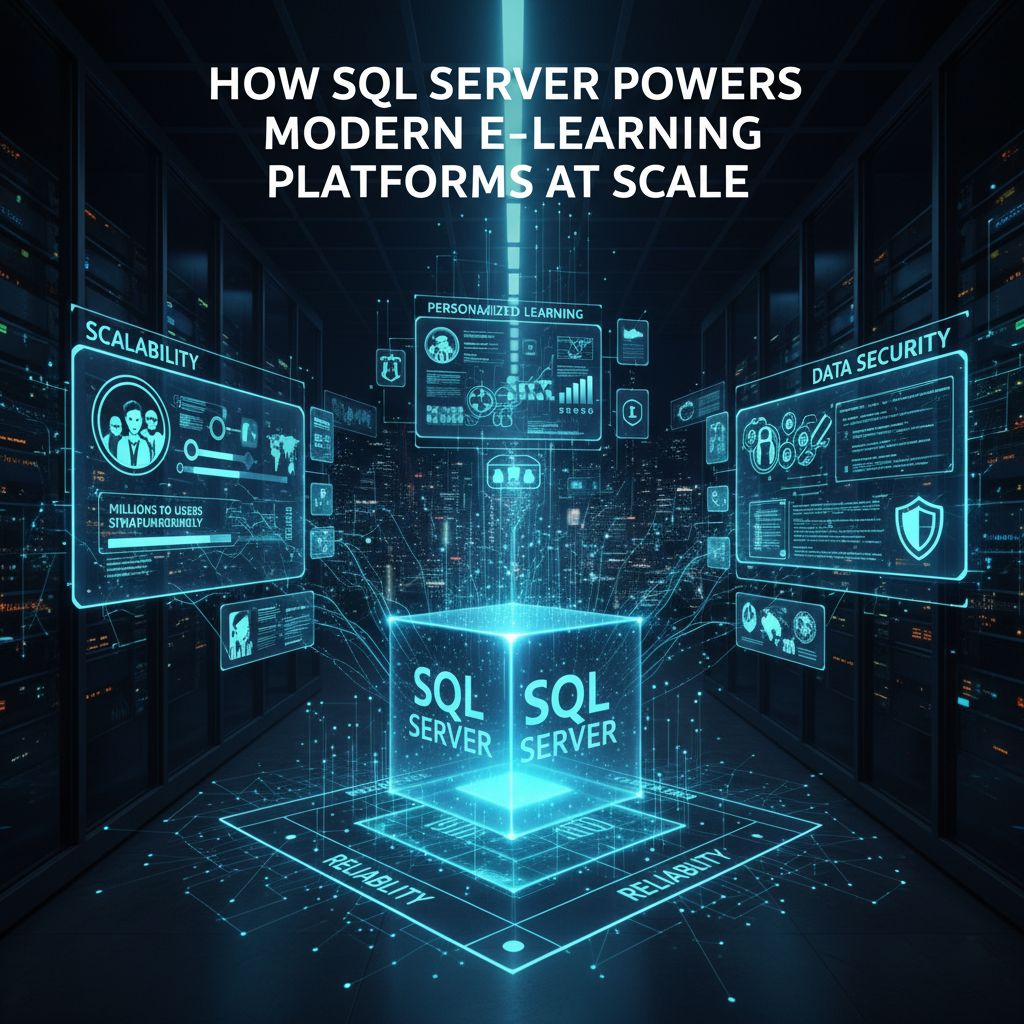
Digital learning has replaced many traditional educational methods. The shift has been from basic websites with static documents to complex, interactive software platforms that support millions of users simultaneously.
The operation of these modern e-learning systems depends on a reliable technological foundation, with a relational database management system as a critical component.
Microsoft SQL Server is a key infrastructure element for many major educational platforms, providing the necessary capabilities for scaling operations, creating personalized user experiences, and maintaining system security.
Many organizations developing or improving their learning systems rely on education software development approaches that integrate SQL Server into the core architecture, ensuring that platforms not only deliver content but also adapt to individual learner needs.
We will now examine the specific technical functions of SQL Server that allow it to handle the substantial data loads of a global e-learning platform, ensuring reliability, high performance, and actionable analytics.
The Core Data Challenges of E-Learning
To understand SQL Server’s value, it helps to look at the data challenges of e-learning platforms. An e-learning platform is a data-intensive application.
Its core functions produce a continuous flow of both structured and unstructured data, including:
- User Management: Identity profiles, roles, and permissions for students, instructors, and administrators.
- Content Delivery: Complete course materials, modules, videos, assessments, and documents.
- Activity Tracking: Detailed logs of video views, quiz attempts, forum contributions, and playback actions.
- Assessment and Grading: Data from question banks, student submissions, scoring, and evaluative feedback.
- Social Learning: Interactions from discussion forums, direct messages, and peer review systems.
A custom e-learning platform is essential for handling this scale of global data. Its development demands strategic planning focused on database design, data access patterns, and system integration to guarantee high availability and low latency.
1. Storing and Structuring Complex Learning Data
The organization of complex learning data in SQL Server relies on a relational model and a normalized table structure. This ensures data integrity and manages the connections between students, courses, enrollments, and content.
A Student table, for instance, links to an Enrollment table, which connects to a Course table; this can further extend to Module and ContentItem tables.
Furthermore, support for JSON and XML enables the storage of semi-structured data, such as flexible quizzes, directly with conventional relational data.
2. High-Concurrency Performance and Scalability
The “scale” in the title is critical. A platform might have millions of users, but the real test comes during peak hours—like the first day of a popular new course or a final exam period. SQL Server is built for high concurrency.
In-Memory OLTP
The In-Memory OLTP feature employs memory-optimized tables to manage high-volume, time-sensitive operations. By accelerating essential functions like video view logging and real-time quiz updates, it processes these actions much faster to avoid performance degradation under heavy load.
Intelligent Query Processing
SQL Server executes complex analytical queries more efficiently via its Intelligent Query Processing capabilities, which include Adaptive Query Processing and Batch Mode. This efficient execution is vital for platforms that must generate real-time reports on student progress.
Partitioning
Large tables, such as one storing billions of student activity events, can be partitioned horizontally. This means data can be split across multiple filegroups based on a key (like date), making management and querying of massive datasets far more efficient.
3. Powering Personalization and Adaptive Learning
Modern learners expect a tailored experience. SQL Server enables this through its powerful data processing capabilities. By storing every interaction, the platform builds a rich profile of each learner.
Stored procedures and complex T-SQL queries can analyze this data to:
- Generate course recommendations derived from completed modules and peer learning patterns.
- Detect learning deficiencies by evaluating assessment results across a student group.
- Launch automated support measures, including sending a supportive notification or recommending review materials upon signs of student difficulty.
This data-driven personalization, powered by the analytics capabilities within SQL Server, turns a generic content repository into an intelligent learning companion.
4. Robust Security and Compliance
Educational platforms are responsible for highly sensitive data, which includes personal identifiable information (PII) and, commonly, financial payment details.
SQL Server offers a multi-layered security architecture that serves as a foundational requirement for any serious platform in this sector.
- Always Encrypted: Keeps sensitive data encrypted continuously—during storage on the server, in transit across networks, and while being processed in memory. This prevents database administrators from seeing plain-text content.
- Dynamic Data Masking: Automatically redacts sensitive fields in the results of database queries. As an example, a support agent would be shown a masked Social Security Number (e.g., XXX-XX-1234) in place of the complete value.
- Row-Level Security (RLS): Governs access to individual rows of data within a table. This mechanism ensures that a student can only retrieve their own records, an instructor can only view data related to their courses, and an administrator keeps full system access.
These features are critical for complying with regulations like FERPA, GDPR, and COPPA, which are non-negotiable in the education sector.
5. Business Intelligence and Advanced Analytics
SQL Server’s data provides strategic value beyond daily operations. Integrated with tools like SSIS and Power BI, it becomes the organization’s definitive data source. Operators leverage this foundation to build dashboards tracking key performance indicators.
These dashboards monitor several key performance areas:
- Course Performance: Operators analyze completion rates and identify specific drop-off points within video lectures.
- User Engagement: Metrics such as daily active users and total time spent on the platform are tracked to gauge user interaction.
- Business Health: Financial and growth data, including revenue, subscription churn rates, and geographic expansion, are consolidated for analysis.
These insights shape marketing and content strategy, maintaining the platform’s competitive edge and effectiveness.
Conclusion
The user-facing features of a modern e-learning platform depend entirely on robust backend systems. SQL Server provides the essential infrastructure required for global scale and consistent uptime.
Its comprehensive duties include structuring complex data, processing millions of simultaneous requests, enabling personalized learning paths, and enforcing security.
These functions establish SQL Server as a fundamental component in the architecture of digital education.
