

If you watched the first matches of the LPL and LCK summer splits kick off on June 3, 2026, and noticed that teams were reaching for champions they hadn’t touched in two years, that wasn’t coincidence. It was preparation — or, in some cases, the absence of it.
Hard Fearless Draft has been the standard across all tier-1 regions since 2025, which means every picked champion is locked out for both teams for the rest of a series. By Game 5 of a BO5, rosters are staring at a pool with up to 40 champions already burned.
The teams that survived those opening rounds on June 3 were the ones whose coaching staff had spent weeks rebuilding pick logic from scratch — not around what a player prefers, but around what they’d still have available in a deciding game.
What does Hard Fearless actually do to a preparation cycle?
The short version: it makes the first game of a series the most strategically consequential draft of the set. Whatever a team picks in Game 1 is gone. Whatever they leave available for the opponent in Game 1 is also gone if picked.
That cascading constraint means coaches can no longer build a comfort-pick menu and rotate through it. They have to map out six to eight viable options per role, knowing that half of them will be consumed or denied before the series ends.
According to the explainer published by esports.gg, Riot Games designer David “Phreak” Turley put it directly: “You must literally know 10 tanks.
If you want to play a tank in game 5, and you aren’t picking first, you better have one.” That quote circulated through analyst discords for a reason. It captures exactly what teams entering the June 3 rounds were up against.
The LPL was actually the first tier-1 league to try any form of Fearless, running a Soft Fearless format in their 2024 Summer season before migrating to Hard Fearless along with every other region for 2025.
That gave Chinese rosters roughly an extra year of institutional knowledge heading into 2026 compared to squads from regions that adopted it later.
Why June 3 specifically created a higher-pressure draft environment?
Opening rounds of a new split are unusual in Fearless because teams are going in with no scouting data on the current split.
There are no VODs from the last six weeks to study. Every team is making educated guesses about what the opponent prepared, which champions they feel comfortable on, and which matchups they want to force.
That informational gap hits harder under Fearless than under standard draft. In a standard format, a team can sacrifice Game 1 on a flex play and adjust once they’ve seen the opponent’s hand.
Under Hard Fearless, Game 1 sacrifices take your best champions off the board whether you won or lost. There’s no real “throw-a-game-to-learn” option anymore.
Several analysts tracking LCK preparation noted that teams like T1 and Gen.G expanded their scrim champion pools significantly during the pre-split boot camp period, per scheduling and roster data on Liquipedia’s LCK 2026 Summer page.
Faker, who has historically relied on a tight rotation of comfort champions, appeared in solo queue on off-meta mid picks throughout May — a pattern veteran observers read as deliberate pool expansion rather than casual grinding.
What the data from 2025 internationals already showed?
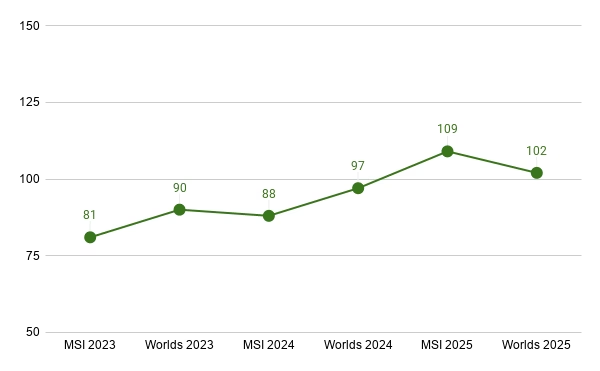
The impact of Fearless on champion diversity is well documented. MSI 2025 saw 109 unique champions across 80 games, compared to 88 at MSI 2024 and just 81 at MSI 2023.
Anyone following video game industry updates through that period would have noticed this data cited repeatedly as evidence that the format was doing exactly what Riot intended — forcing rosters to go broader.
Worlds 2025 was the first Worlds since 2015 to record more unique champions than total games played, meaning on average at least one previously-unpicked champion entered every single match.
Those aren’t abstract numbers. For coaches preparing the June 3 opening rounds, they meant that any champion sitting outside their player’s practiced pool had a realistic chance of being the only viable option in a late-game situation. The players who couldn’t adapt — or whose rosters hadn’t done the pre-split work — were exposed quickly.
One Reddit thread in r/leagueoflegends in late May 2026 had coaches and analysts debating which LPL teams had genuinely deepened their rosters versus which were relying on lane dominant picks to avoid the pool problem.
The consensus from that thread: BLG and EDG entered June 3 with the widest documented champion flexibility, partly because their top laners had been grinding less-played juggernauts in ranked throughout May.
How the tactical preparation cycle actually changed?
This is where things get concrete. Under standard draft, a pre-split preparation cycle looks roughly like this: identify the current meta tier list, have players clock in extra hours on S-tier picks, build a BO5 strategy around two or three core win conditions.
Under Hard Fearless heading into June 3, that process added an entire layer. Coaching staff in both the LPL and LCK were running 6-game scenario maps — essentially scripting out hypothetical series and checking whether their roster still had workable champion options in each position by Game 6 of a theoretical extended run.
If the answer was “our jungler has Nidalee, Graves, Lee Sin, Vi, and not much else,” that player was in scrims on Bel’Veth, Hecarim, and Ivern before the split started.
Former LEC mid-laner Nemesis, who played in the LEC during the Fearless transition, addressed this on stream: “The complaint that players will be forced to play champions they’re not good at is over-exaggerated and, for the most part, false.
If players are not good enough to pilot multiple champions at a good enough level, then they shouldn’t be in the LEC — or whichever league they’re on.” His point applies directly to LPL and LCK players entering June 3. The format doesn’t forgive narrow pools.
Which role felt the pressure most on June 3?
Top lane. It’s not particularly close. The top lane pool under Hard Fearless depletes faster than any other position because tanks, bruisers, and split-pushers frequently get targeted in Game 1 to deny them for later. By Game 4, a top laner who came in with five champions is functionally at one or two.
Heading into the June 3 opener, you kept hearing coaches and analysts reference this problem specifically for LCK top laners. Zeus (T1) and Kiin (Kwangdong Freecs), two of the most accomplished tops in the region’s history, both had documented scrim activity on at least 8 different champions in the month of May, according to sources tracking solo queue account activity covered by ESPN Esports. That number is high by any pre-Fearless standard.
The broader shift across both leagues was an increase in early-game style flexibility. Teams stopped building prep around a fixed identity — “we are a teamfight composition team” — and started building around a conditional tree: if the opponent takes X, we go to Y; if Y is also gone, Z needs to be viable.
What this means for how you watch the splits going forward?
If you’re following the LPL or LCK this summer and want to understand what’s actually happening in draft, the question to ask before each game isn’t “what is this team’s best composition” but “what have they already burned, and what do they still have to work with?” That context makes every draft decision three times more interesting.
The teams that understood Fearless as a preparation problem rather than a draft-phase problem were already adapting months before June 3.
Those that treated it as something to figure out in the moment — you’d see it quickly in how thin their options became under pressure. The format makes that visible in a way that standard draft simply doesn’t.
Tracking how well teams preserved their best champions for closing games will tell you more about coaching quality than almost any other metric this split. That’s the lens worth keeping in mind every time the draft phase opens.
