

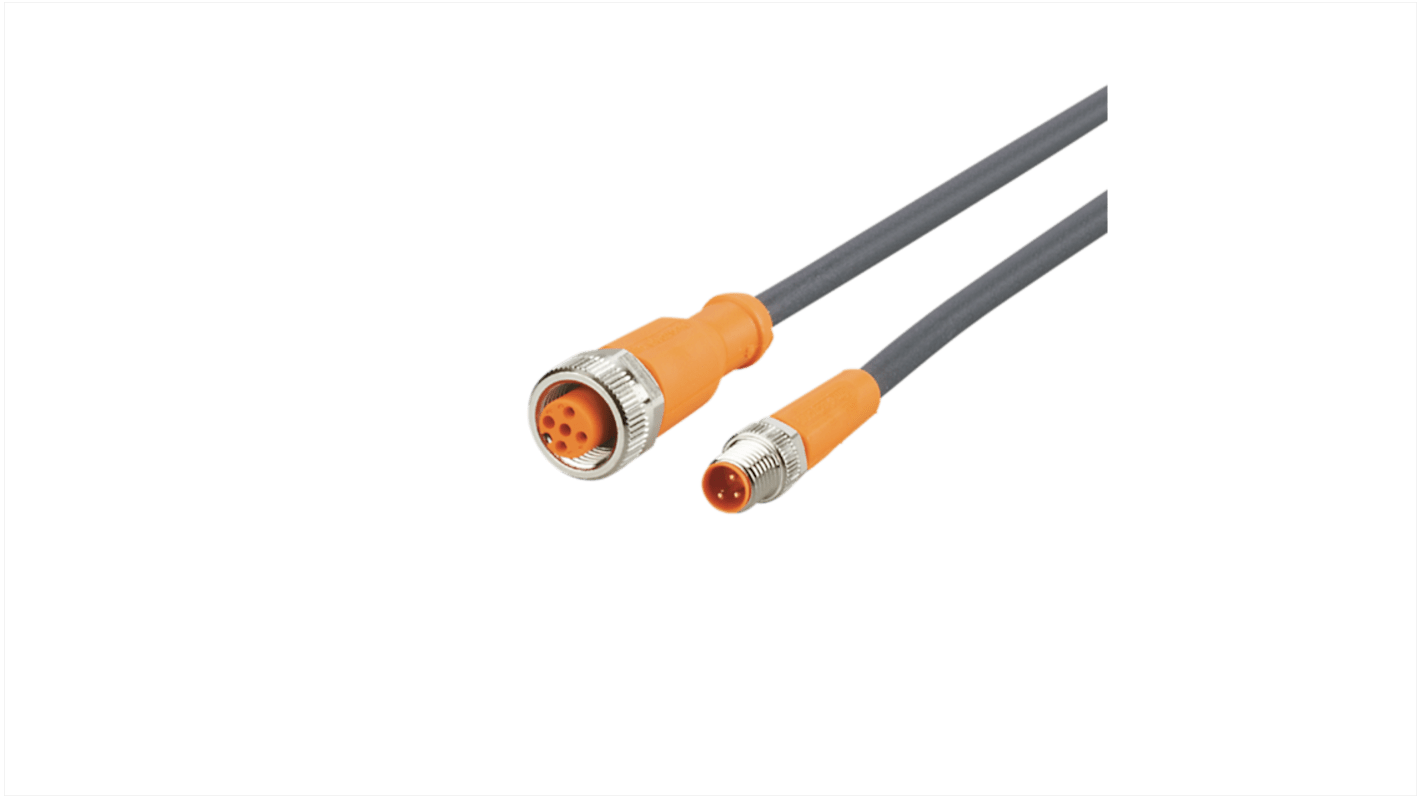
According to the Senseye True Cost of Downtime study, large industrial plants lose an average of 323 production hours per year to unplanned failures, at a cost of $532,000 per hour, and a disproportionate share of those failures trace back to connection failures rather than major equipment breakdowns.
Cables and connectors are among the highest-frequency failure points in industrial automation cable systems, which makes the specification decision far more significant than it might appear at first.
IFM Electronic has been producing connection technology for over 50 years, and the company’s cable range is purpose-built for the conditions that cause generic solutions to fail: washdowns, welding spatter, extreme temperatures, chemical exposure, and continuous mechanical stress.
The IFM cable lineup spans cordsets for general industrial automation through to specialized variants for food and beverage, welding, mobile machinery, and hazardous areas.
This article covers how IFM builds durability into its cables at the design level and which variants suit which demanding applications.
What Sets IFM Cables Apart at the Construction Level?
IFM cables are built around overmolded connector technology that eliminates the weak point where cable meets connector. Standard connectors with separate strain relief fittings create a flex zone where repeated movement causes fatigue and eventual wire fracture.
IFM’s overmolded ecolink design bonds the connector and cable jacket into a single monolithic assembly, creating a watertight barrier and removing that failure point entirely.
Jacket Materials Matched to Application Conditions
IFM offers cables for industrial applications in multiple jacket materials, each selected for a specific exposure profile:
- PUR (polyurethane): High mechanical toughness, excellent chemical resistance, suitable for dynamic routing and continuous flex applications; used in welding environments where resistance to spatter and oils is critical
- PVC: Cost-effective option for less demanding general industrial use where chemical exposure is limited
- TPU/TPE: Used in food and beverage variants; silicone-free construction prevents contamination concerns in pharmaceutical and paint shop applications
Connector Features Built for Reliability
The ecolink series incorporates an integrated mechanical end stop in the coupling nut that prevents over-tightening and O-ring damage – a common cause of seal failure in standard connectors.
A special vibration protection mechanism prevents connectors from loosening under continuous machine vibration, which is a persistent problem with generic M12 fittings in motor-adjacent installations.
How Do IFM Cables Handle the Harshest Industrial Conditions?
Industrial cables rated for harsh service need to satisfy protection requirements across multiple simultaneous stress factors, and IFM designs its cable families with specific approval sets for each target application.
Welding Applications: Spatter Resistance by Design
IFM’s welding cordsets use PUR jacketing and a weld-coated brass locking mechanism, with gold-plated contacts for corrosion resistance. The halogen-free cable construction can be recycled at end of life and is tested for resistance to welding sparks.
The EVW107 series, for example, uses an M12 straight connector with weld-coated brass locking nut – a detail that prevents the connector from seizing to the mating device under spatter accumulation.
Food and Beverage: IP69K and Regulatory Compliance
Food processing lines require cables for industrial applications that withstand high-pressure, high-temperature steam cleaning.
IFM’s food and beverage cable range achieves IP68 and IP69K ratings – the highest dual protection level for dust and water ingress – with silicone-free jackets that comply with food safety requirements.
According to IFM’s ecolink connection technology specification data, food and beverage variants combine IP67/IP68/IP69K ratings with temperature ranges from -40°C to +90°C and high-grade stainless steel or TPU housing materials suited for exposure to salts, oils, and coolants.
Hazardous Areas: ATEX Certification
For explosive atmospheres, IFM produces connectors certified by DEKRA EXAM under ATEX standards, with EC type examination certificates valid across EU countries.
The relevant cables use the same M8 and M12 connector families as the standard range, which simplifies inventory management in facilities with both standard and hazardous zone installations.
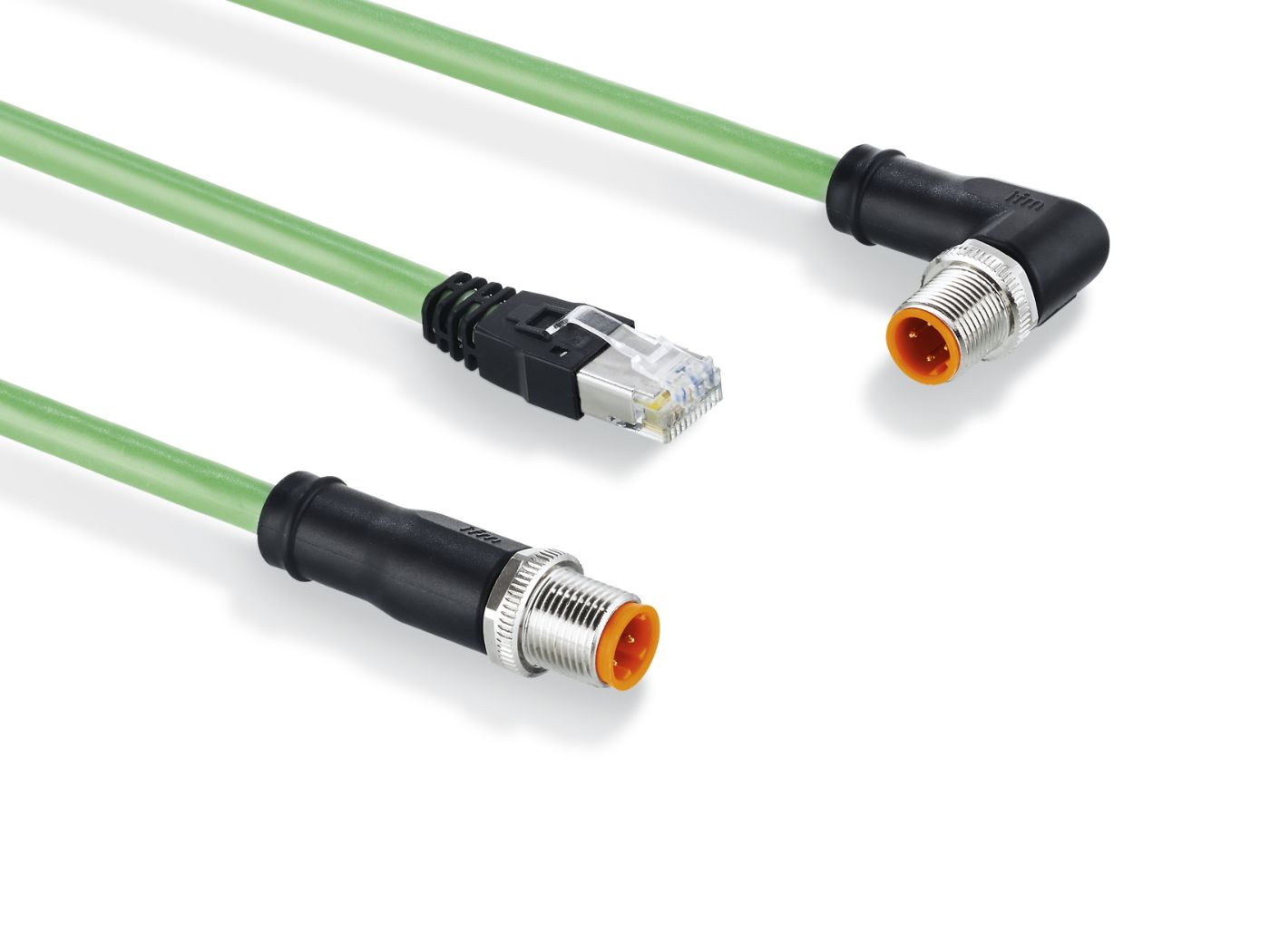
IFM Cable Types by Application: A Comparison
| Cable Family | Jacket | Key Approvals | Typical Use |
| Standard cordsets (ecolink) | PUR, PVC | IP67/IP68/IP69K | General industrial control, sensors |
| Food & Beverage | TPE/silicone-free | IP69K, FDA-compliant, Ecolab | Wash-down processing areas |
| Welding | PUR, halogen-free | UL, weld-coated connector | Welding cells, robot arms |
| Mobile machinery | PUR, TPU | IP67/IP68, vibration-rated | Construction, agricultural vehicles |
| ATEX hazardous area | PUR | ATEX, DEKRA EXAM certified | Explosive atmospheres |
| Industrial Ethernet | Screened PUR | IP67, Cat 5e/Cat 6a rated | PROFINET, EtherNet/IP backbones |
How to Specify the Right IFM Cable for a Given Installation?
Selecting from the IFM cables range follows a logical sequence once the application conditions are documented:
- Define the protection class required: identify the worst-case liquid and dust exposure; IP67 covers immersion to 1m, IP69K adds high-pressure wash resistance
- Identify mechanical stress factors: continuous flex for robot arms needs dynamic-rated PUR; static routing can use standard grades
- Confirm the connector format: M8 for space-constrained sensor connections, M12 for standard industrial use; pin count determines the coding (A, B, D, X-coded for Ethernet)
- Check chemical compatibility: welding, cutting oils, and cleaning agents all affect jacket life differently; PUR handles most industrial chemicals; TPE suits food-grade requirements
- Verify certification requirements: ATEX for hazardous zones, FDA/Ecolab for food processing, UL for North American compliance
Tip: IFM ships 90% of orders in one hour from U.S. stock, which means cable selection can be optimized for the application rather than defaulting to whatever is locally available.
Backing the Specification with a 5-Year Warranty
IFM backs its industrial automation cables with a 5-year product warranty across the range – a commitment that reflects confidence in the construction quality and differentiates the product from lower-cost industrial cables with shorter or no warranty coverage.
FAQs
Are IFM cables compatible with other brands’ M12 sensors and actuators?
Yes. IFM uses standard M8 and M12 connector formats that comply with IEC 60947-5-2 and related standards, making them physically and electrically compatible with M12-equipped devices from Siemens, Balluff, Turck, Pepperl+Fuchs, and other major brands. Coding type (A, B, D, X) must match the device side, but otherwise cross-brand compatibility is standard.
What does “silicone-free” mean on IFM’s food and beverage cables, and why does it matter?
Silicone contamination causes adhesion problems in paint shops and can create FDA compliance issues in food processing. IFM’s silicone-free cable constructions use TPE or PUR jackets and gasket materials without silicone compounds, which allows the cables to be used in paint lines and food processing areas where silicone contamination would spoil products or cause coating failures.
How does the ecolink end stop prevent connector failure, and why do standard connectors lack this feature?
Standard M12 connectors rely on the installer applying consistent torque with a spanner, which in practice often means over-tightening that deforms or cuts the O-ring. IFM’s mechanical end stop physically limits coupling nut travel to the correct sealing position regardless of applied force. The feature adds minor manufacturing cost, which is why it is not present in commodity connectors.
What is the difference between IP67, IP68, and IP69K, and when does each rating become the deciding factor?
IP67 protects against immersion to 1 meter for 30 minutes. IP68 extends that to greater depths and durations as specified by the manufacturer. IP69K adds protection against high-pressure, high-temperature jet cleaning at close range. For wash-down applications in food processing or pharmaceutical production, IP69K is the minimum useful rating because IP67/IP68 do not test against the pressure and temperature of cleaning jets.
Can IFM Ethernet cables be used in PROFINET and EtherNet/IP systems interchangeably?
IFM Industrial Ethernet cables using M12 X-coded or D-coded connectors are physically compatible with both PROFINET and EtherNet/IP infrastructure. Protocol-level compatibility depends on the devices and switches being configured correctly, not on the cable itself. Cat 5e cables are sufficient for 100 Mbps PROFINET; Cat 6a screened PUR is recommended for Gigabit applications.
How do IFM cables perform in high-flex robot arm installations?
IFM’s dynamic-rated PUR cables use stranded conductors with a high number of fine wires per conductor – the EVW107 welding cable specifies 42 x 0.1 mm strands per conductor – which gives the cable the bending endurance needed for continuous flexing in robot arms. A special polyester fleece strip foil inside the cable protects against torsional stress damage over extended cycle counts.
Is there a standard way to check whether an IFM cable is genuine versus a counterfeit or substitute?
IFM products can be verified through the part number on the IFM website, where full technical data sheets, certifications, and approval documentation are publicly available. Cables sourced through unauthorized channels may lack the correct certification markings, use lower-grade jacket compounds, or have inconsistent connector tolerances that affect sealing performance. Purchasing through authorized distributors with traceability documentation is the reliable approach.
