

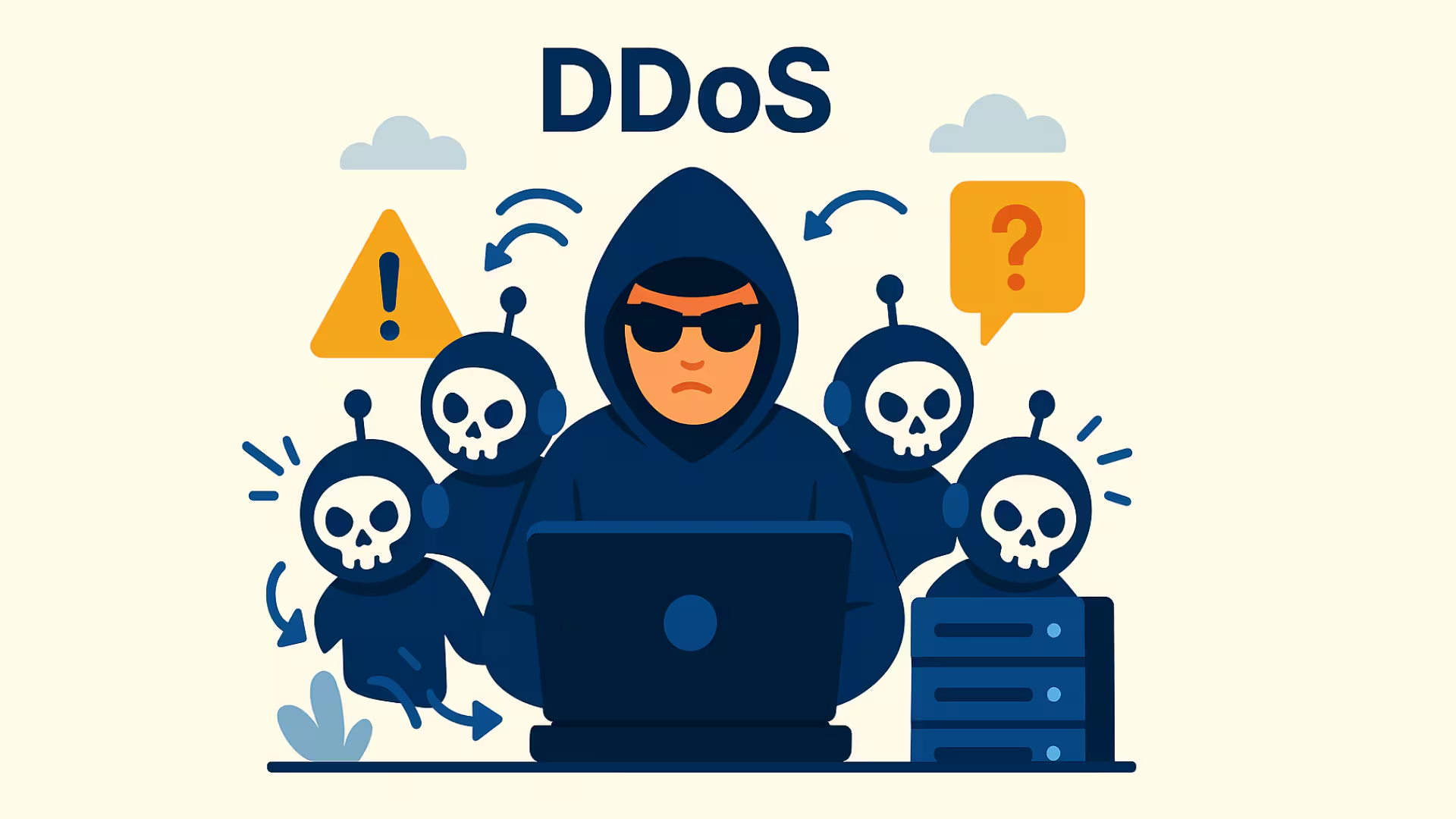
When people hear “DDoS attack,” they picture a website getting knocked offline by a flood of traffic. That’s the headline version.
For small and medium businesses (SMBs), the real damage is usually quieter and messier: canceled orders, support overload, wasted ad spend, and a team that loses a day (or week) to firefighting.
A DDoS doesn’t have to take you fully down to hurt you. Sometimes it just makes everything unreliable: pages load slowly, payments fail, dashboards time out, and customers retry five times and then give up. And for an SMB, that can be just as costly as a total outage.
Downtime is obvious; the aftershock is what really hurts
If you sell online, offer bookings, or collect leads, downtime hits revenue immediately. But the higher cost often arrives after the site “comes back”:
- Lost momentum: customers who leave don’t always return later. They just buy elsewhere.
- Wasted marketing spend: your ads and email campaigns keep running while your landing pages fail.
- Sales disruption: even a few hours of missed leads can throw off a week’s pipeline.
In other words, you don’t just lose transactions; you lose trust and flow.
Your reputation takes a hit, even if nobody says it out loud.
Most customers won’t think, “They’re under attack.” They’ll think, “This site is glitchy.” That’s a brutal label for a smaller brand trying to compete with larger, more polished players.
You might notice it as:
- fewer repeat customers the following week
- more abandoned carts
- nervous questions like “Is payment working?” or “Is your site safe?”
Even if no data was breached, reliability is part of credibility.
The hidden bill: your team’s time (and attention)
SMBs run lean. So when a DDoS event hits, it pulls everyone into the same emergency room:
- developers stop building and start chasing logs
- whoever “knows servers” becomes the incident lead
- someone has to answer customers, update social channels, and calm stakeholders
- management gets dragged into vendor calls and status updates
This is where the true cost balloons. The attack isn’t only interrupting your website; it’s interrupting your business.
Emergency fixes cost more than planned protection
Under pressure, companies make fast decisions:
- upgrading hosting plans mid-incident
- paying for urgent help from consultants
- adding tools without time to configure them properly
- changing settings that later cause performance or SEO issues
It’s not that these decisions are wrong; it’s that they’re made in panic mode. The bill tends to be higher, and the outcome is usually “good enough for now,” not “solid for the next 12 months.”
Partial outages can be worse than a clean shutdown
A full outage is clear: you know it’s broken. A slow, unstable site is harder. Customers can load the homepage but can’t log in. Checkout fails on step three. APIs intermittently time out. Your team gets stuck in that awful loop of “Is it fixed?” No… maybe… wait…”
This kind of degraded performance creates the following:
- duplicate orders and payment confusion
- retry storms (your systems hammer themselves)
- a flood of support tickets that take days to clear
Third-party tools can break in ways you don’t expect
Most SMBs rely on integrations: payment gateways, CRMs, shipping tools, analytics, and email platforms. During a DDoS event, your site may start failing webhooks, missing callbacks, or sending repeated requests.
Vendors may throttle you to protect themselves, and suddenly you’re dealing with a second problem: your systems can’t talk to the services you depend on.
So the incident spreads fast.
DDoS can be a distraction, not the main event
This part is under-discussed. Sometimes a DDoS is used to pull your attention away while attackers try something else: credential stuffing, admin login probing, or taking advantage of rushed configuration changes.
That’s why it’s smart to treat DDoS as a security issue, not just a “traffic problem.” Having sensible monitoring, rate limiting, and DDoS protection in place reduces the odds that disruption turns into something more serious.
The long-term cost: hesitation
After an incident, many SMBs change behavior:
- delaying launches
- avoiding promotions (“What if traffic spikes again?”)
- being slower to ship because everyone fears instability
That invisible slowdown can cost more than the outage itself because it impacts growth.
What SMBs can do (without an enterprise budget)?
You don’t need a huge security team to improve your odds:
- Put your app behind a reputable CDN/WAF with rate limiting
- Lock down admin routes and APIs with stricter controls
- Set a basic incident plan: who contacts hosting/CDN, where logs are, what you communicate
- Monitor the simple signals: traffic spikes, error rates, login anomalies
Bottom Line
For SMBs, the hidden cost of a DDoS attack isn’t just “site down.” It’s lost sales momentum, stressed teams, expensive emergency fixes, customer doubt, and days of cleanup.
The best time to address it is before you’re under pressure when you can make calm decisions that protect both uptime and reputation.
